
About
I had a brief tryst with dirt bikes while living in Pennsylvania as a kid, but my romance with motorcycles didn’t blossom until I was well into my twenties. In 2019, I was a junior banker who had lucked into traveling for his first client meeting in Baltimore. I remember standing on a street corner on my way to the office, resplendently dorky-looking in suit and tie, when a gentleman astride a beautiful black-gold shadow of a motorcycle rolled by me on his way towards parts unknown. I almost broke my neck; I had no idea what this motorcycle was, but I swore I would own one someday.
As it happens, that motorcycle was a Ducati (the 803cc Scrambler Cafe Racer in Black Coffee livery, to be specific). It was my third motorcycle after stints with Suzuki and Royal Enfield, but it was the first one to inspire any loyalty. The ergonomics, size, and agility made it feel like Bologna had made this motorcycle just for me; I fell in love with it and brought it with me to Los Angeles, where I still own and ride it now. Other Ducatis may call upon Prometheus’s fire with greater fervor, but I like this air-cooled steed the best.


My Ducati Scrambler as captured by Ashton Photography at the Distinguished Gentlemen’s Ride, Atlanta 2024.
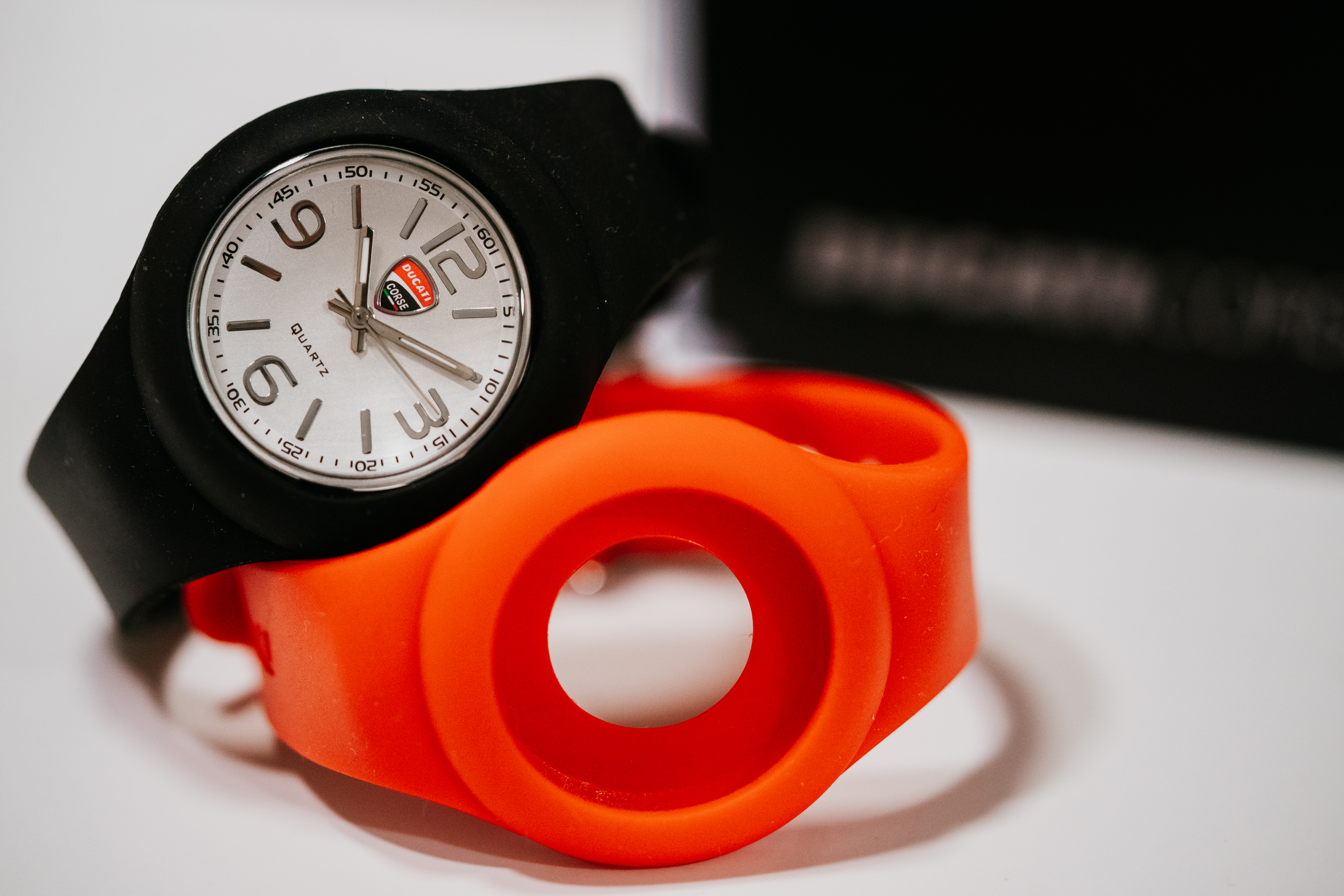
My experience with motorcycling has led me to meet wonderful people on both coasts, many of whom share my fondness for Italian bikes designed by the Shield. One of those people is my good friend Richard, a fellow MotoGP enthusiast who possesses a particular knack for repairing and riding 999s. Richard is a kind soul and recently gifted me a Flip watch made by Ducati. It is a lovely quartz timekeeper where the case and strap is one integrated silicone piece that cradles the watch, meaning you can swap readily between the options that came with it depending on what color you desire. We’ll cover the Flip watches in detail later. For now, “rad” is the most succinct description I can give you.

Richard’s gift inspired a research bonanza. The marriage of watches and cars as a mechanical pairing is as prolific as peanut butter and jelly; in contrast, the overlap between watches and motorcycles isn’t nearly as widespread. Deus and Breitling aside, regular collaborative efforts between these two worlds are sporadic. Ducati does have some history in this department, but most of it isn’t well-cataloged. Therein lies the genesis of this article and my offering to you: a recent history of Ducati’s intersection with the watch world, or at least as much history as I can deign to piece together through force of will (aka the power of Google).


The Breitling x Deus Top Time 2024 edition. Images: Deus
Our timeline will take us from the late 90s to current day. There are some common themes that will repeat throughout this article, most noticeably the use of carbon fiber, motorcycle instrument-inspired dial font, sandblasted finishing, Ducati red as a dial color, and the predominance of chronographs given their obvious connection to motorsports history. Some of these timekeepers will err on the loud side of watch design, possibly beyond what may be deemed tasteful to the general public. I have no doubt you will make your own determination on a case-by-case basis as to their attractiveness or lack thereof.
Note: this is not an article on the history of Ducati or any of the watch brands mentioned, and periodic updates may occur as new information is brought to my attention. I am also excluding generic low-quality “fashion” watches that I have deemed too likely to be confused with watches from a shopping mall stand. Those watches are generally classified as cartoonishly oversized and exclusively quartz (although there are quartz watches in this article, and they have a ton of character). Let’s get to it.
Fly With Ducati: Fortis (1998 – 2003)

Fortis Watches has been around since 1912, when Walter Vogt founded the company in Grenchen, Switzerland. Fortis’s pedigree matches its longevity; it was Vogt, in partnership with John Harwood, who brought the first automatic wristwatch (emphasis on wrist here) to market at Baselworld in 1926. Space exploration and aviation is Fortis’ dual legacy, as Fortis was named the official partner of Roscosmos, Russia’s space agency, in 1994. The company even has a history of supplying unit-specific watches to squadrons of various nations including but not limited to Germany, Switzerland, and Hungary. In short, Fortis is as much about the use of watches in a professional application as Sinn or any other tool watch competitor.
Even with historical check marks as good as these, Fortis remains unrecognized. The business strategy is probably to blame: a focus on eastern Europe led to a malnourished dealer network elsewhere and a failure to understand e-commerce before it was too late. Fortis also leaned away from tool watches with art-first designs like the Sachs collection. The end result was financial restructuring in 2017, and subsequently led to the company’s acquisition by Fortis fan and current CEO Jupp Philipp the following year. Under his stewardship, the company is once again leaning into its tool watch roots and appears far healthier.
Fortis’s absence in the west combined with their focus on aviation explains why the company’s brief foray into another world, motorcycling, is also largely forgotten. The 90s belonged to Italy; Carl Fogarty would win his third of four World Superbike championships and Ducati’s fourth out of five by 1998, and had painted the decade in Ducati red with a 916-shaped brush. 1998 marked the first bi-annual World Ducati Week (“WDW”), and it would kick off the “Ducati World Champion Edition” watch collection that Fortis would produce over the next five years.
World Ducati Week Limited Edition

The first Fortis-Ducati watch, the small quartz WDW Limited Edition 560.10.132, was released in 1998 to commemorate both Ducati’s World Superbike victory and that inaugural World Ducati Week. The dial intentionally resembles the tachometer found on both the Ducati 748 and 916; it faithfully features “RPM x 1000” in the bottom right quadrant and an oil “check light” at 3 o’clock. On the reverse side, the caseback has “WDW 1998” stamped above 6 o’clock. Sandblasted aluminum casing and hidden lugs aside, the WDW Limited Edition also has the distinction of being the only non-aviation inspired Fortis watch used for the Ducati collection.

Fortis Ducati Fliegers

In 2000-2001, Fortis promptly reverted to its aviation roots for their next release commemorating Ducati’s World Superbike dominance. This time, they released two 40mm stainless steel Flieger models; each are respectively a derivative of their Pilot Professional Day-Date and Flieger Professional Chronograph. Both are visually distinct through their Ducati branding, oversized crowns, carbon fiber-weave dials, and sandblasted finishing. Both watches are also marked “T Swiss Made T” denoting the use of tritium indices; given tritium-based paint was banned in 1998, it is possible that these watches are some of the last non-gas tube dials used by any brand.

The Pilot Professional Day-Date, ref. 595.22.158.1, had a production run of 2,000 units and is the more common of the two siblings. This classic pilot’s watch is powered by an ETA 2836-2 and has been modified to use a carbon fiber-weave dial. The Ducati shield appears at 6 o’clock instead of the standard “Automatic” text, and the seconds hand is now appropriately red instead of orange. This Ducati version shares the same reference number as the non-limited model; it appears that Fortis took existing casebacks and simply stamped them with the unit number and “Ducati Limited Edition.”


Note the Ducati-style caseback (left) versus standard (right). Images: Etsy, eBay

The penultimate model of the collection, the Flieger Professional Chronograph 597.22.141.21, was produced in a smaller batch of 1,000 units. This pilot chronograph uses the automatic, cam-actuated ETA (Valjoux) 7750 as evidenced by the 6-9-12 subdial layout, and displays a 12-hour totalizer, small seconds subdial, and 30-minute counter in that order. This is not the first time we will see a Ducati-branded watch use a 7750 or 7750 derivative given its utility; it is automatic, comes with a day-date indicator, and is both easily serviceable and modifiable. Unlike the previous Flieger, the Ducati-branded Professional Chronograph does not share a reference number with the base model (597.10.141).


Image: Delray Watches
These Fortis Fliegers can only be what they are, and function overwhelmingly beats out form; the printed dials don’t have much visual depth, and I wouldn’t describe the cases as being sculpted with the deft hand of an artist either. They are very legible and easy to read, however, and the use of tritium alongside the next Fortis watch distinguishes them against all other watches on this list. Consider their utilitarianism a blessing if you are gifted with the opportunity to purchase one.
A Chronograph for Cosmonauts (And Motorcycle Riders)

The last Fortis-Ducati model, the 2003-vintage Official Cosmonaut Chronograph 602.22.142, was made in the smallest batch at 500 units total. It’s almost tradition at this point that each Fortis watch shares the reference number of a non-limited model, and the Cosmonaut is no exception. The Cosmonaut stands out over the Fliegers in that it was professionally issued to Russian cosmonauts (hence the name) when Fortis began their partnership with Roscosmos in 1994. The Fortis Cosmonaut is objectively not the P.R. equal of the Omega Speedmaster in the west, nor has it called outer space home as long; that being said, if there is a watch that represents the spaceborne horological dreams of the eastern bloc, the Cosmonaut is it.
The Cosmonaut shares the stainless steel construction and sandblasted finishing of its Flieger cousins, but is sized more approachably at 38mm. It has tritium indices, screwdown pushers to match the crown, and a steel tachymeter bezel, all of which combine to give the Cosmonaut a Daytona-like case profile. The Cosmonaut is a central minutes chronograph, meaning the minutes are not displayed on a subdial but rather via a useful fourth hand that is visually identified by a colorful “airplane” tip. These watches were presented in a gas tank-style box, and were offered with a red nylon strap and blue leather strap with red stitching.


That airplane-tipped central minutes hand and the movement that drives it is the reason why the Cosmonaut is my pick for the best watch of the quartet. Before its update as the upsized B-42 by the end of 2003 (now 42mm and using an ETA 7750), the Cosmonaut used the Lemania 5100 as its engine. The 5100 is automatic and cam-actuated like the 7750, and also has a 6-9-12 subdial layout; however, the 12 o’clock subdial is naturally now a 24-hour counter instead of a 30-minute timer.

The Lemania 5100 is a special movement in the history of chronographs. It is a continuation of the previous 1340, but introduced day calendar functionality and nylon parts as a cost-cutting measure. The 5100’s additional supports along the sides and direct drive system made it a highly shock-resistant movement, and various militaries took note of its affordable robustness. The original Porsche Design Chronograph, which we touched on briefly while covering Iceman’s watches from Top Gun, is powered by a Lemania 5100 and was used by Germany as the first military-issued watch. Numerous brands including but not limited to Omega, Tutima, Sinn and Heuer (due to ownership by Nouvelle Lemania) all used the 5100. Given its history, this movement has a seat at the table for many an enthusiast.
A Shield For A Shield: Tudor (2011 – 2020)
Fastrider Chronograph

Hans Wilsdorf might have originally intended Tudor in 1926 to be the frugal alternative to Rolex, but there is no denying that the brand has forged its own path since the turn of the century. During the teens, Tudor was proliferating a diverse spread of chronographs including the Hydronaut II, Iconaut, Grantour, Fastrider, and Heritage models. All five lines were actually produced with partial overlap to the Black Bay, which came out in 2012; Heritage chronograph aside, they represent the last vestiges of Tudor before it embraced retro “Black Bay-ification.”


Tudor’s grammar of design during this era was dominated by funky dials and heavy polish, and there is a general criticism (not wholly unfounded) of garishness leveled at these chronographs. Still, there are flowers to be given for experimentation and certain complications are most accessible by reaching for the older models. Before the Pelagos FXD Chronograph, the Hydronaut II was the only chronograph diver made by both Tudor or Rolex. Want a chronograph with a GMT hand? It’s still the Iconaut. Want a flyback chronograph? If it isn’t Rolex’s Yacht-Master II Regatta, it is the Grantour.
History oft repeats itself in the watch industry, and Tudor is no exception. In the same way that there was the Hydronaut II before there was the Pelagos FXD Chronograph, there was Ducati before there was Red Bull. Enter the Fastrider collection, which Tudor produced from 2011 to 2020 as a collaborative project with the Italian Shield from down south. The Fastriders can be considered special editions, not limited editions; while not widespread, there was no official cap on their production.

A Fastrider 42000 series in black with no numerals. Image: eBay
The Fastriders take their Big Block heritage seriously and are prosperously sized, sitting at 14.5mm thick with a 42mm case diameter and a 24mm lug width. They are equipped with the ETA 7753, a 7750 derivative that has been rotated on its side to support a typical 3-6-9 subdial format. One area where the Fastriders represent an upgrade over the Fortis watches are the subdials; all three are raised with graduated flanges and more premium hands, which enables the dial to engage you with its topography.


Images: eBay
One quirky feature of the 7753 necessitated by the new movement orientation is the recessed Shield-shaped pusher at 9 o’clock, which is a quickset date adjuster that is used instead of rotating the crown like most other watches. Even with three buttons, the Fastrider still maintains an impressive water resistance of 150 meters. These chronographs usually came with one or multiple of a Tudor three-link design bracelet, leather strap, or nylon NATO alternative.
Look closely as you go through each series and you will notice there is no mention of Ducati to be found on any Fastrider. This collection was clearly intended to avoid the all-too common sin of watch-motorsport collaborations that is dial clutter. It should be noted that Tudor and Ducati did produce co-branded marketing materials though like this particular lifestyle advertisement, where the same actors riding Scramblers are also wearing Fastrider chronographs.
The Original: 42000 Series


The other original Fastriders: panda, panda with numerals, and black with numerals. Images: Watchfinder, Bonham, Luxury Time
The biggest differences between each Fastrider generation comes down to the dial and materials. The original series, the 42000, was produced from 2011 to 2016 and has a conservative aesthetic given its steel construction and finishing. You can get this budget Daytona look-alike in a myriad of slightly different executions. There are two 42000 colorways, panda and all-black, that then come in both Arabic numeral and non-numeral configurations. All of them have a grey racing stripe that runs down the right hand side of the dial, which bisects the 30-minute subdial and circular date aperture at 4:30.


The 42000D. Images: Bob’s Watches
There’s one more option in the initial series if you really want to fly the Tricolour around town: the Fastrider Ducati 42000D. This version has a Ducati red dial with Arabic numerals, and we know that at least this execution came with the Ducati shield on the box. There’s something about the 42000D that reminds me of the Schumacher Speedmasters; both are interesting budget chronograph choices, but I personally leans towards this Tudor Fastrider. Your mileage may vary after scrutinizing both options.
Black Shield Series: 42000CN and 42000CR


Images: ABTW, Tudor
The Black Shield was made from 2013 until the Fastrider was discontinued in 2020. This watch uses a matte black monobloc ceramic case and came with either red accents (42000CN) or tan accents (42000CR) to start. A second 42000CN execution with white accents, the xDiavel, was made in 2015 in honor of the Ducati motorcycle with the same name. The Black Shield is simultaneously far more avant garde and far less legible than the Fastriders that came before it, but it is also the most wearable. No other Fastrider neutralizes the large case profile like the Black Shield does given its lightweight ceramic case and slimming noir coloration.
We haven’t even discussed pricing yet, which makes the Black Shield even more attractive. Fastriders can easily be had for $3,000 – $4,000 USD with some searching on the secondary market, and that includes this Black Shield; there is no premium for the monobloc ceramic case. At Count Sunny Hours, we scientifically define this arbitrage opportunity as “a steal.” I say turn the market efficient, if you have the capital to do so.
Scrambler Series (42010CN) Plus One Bonus

The Fastrider Scrambler 42010N was made from 2015 to 2018; like the xDiavel before it, this watch was also made to commemorate a production motorcycle line in the then-new Ducati Scrambler. The Scrambler Fastrider mixes traits from the previous two gens; it has a steel case like the 42000 series, but a ceramic bezel and black PVD-coated pushers like the 42000CN/CR. It is thoroughly Rastafarian and was produced in three Scrambler colorways: ‘62 Yellow, Ducati Red, and Wild Green. The Icon was and still is produced in ’62 Yellow and Ducati (Velvet) Red, while Wild Green was the scheme for the short-lived Urban Enduro.
Scholarly Pursuits

A brief word on education is warranted, if you will indulge me. Interestingly, the Tudor Fastrider was once a watch model that Rolex-certified watchmakers built as graduation watches. At least two schools, the Swiss American Watchmakers Training Alliance and Lititz Watch Technicum, would send watchmakers a Tudor chronograph (sometimes the Fastrider) to assemble and finish their training. This tradition happened at least through 2018 for SAWTA and 2021 for Lititz; it is unknown if watchmaking schools still offer Tudor chronographs or any other watches at time of graduation.

Ducati Branded Watches (2015 – Unknown, Discontinued)
Point Towards The Land of Joy: The Scrambler Compass Watch

Not content to solely celebrate the Scrambler via their partnership with Tudor, Scrambler Ducati (a subsidiary of Ducati proper) released a watch as well with the 40mm ref. 987691869. This brushed steel watch is powered by a Miyota 2115 quartz movement, has 100 meters of water resistance, and came stock on an olive drab NATO strap. The most interesting feature has to be the compass bezel; this watch aside, the Hamilton Khaki Field Expedition and Certina DS-X GMT are the only watches I can think of in recent memory that are equipped with one. It is definitively a rare feature to find on a tool watch.

To use a compass bezel, you must first harness the unbridled power of the Sun. Keep the dial level and simply point your hour hand at the Sun; from there, rotate the bezel so that the north or south indicator (the opposite of whatever hemisphere you are in) is halfway between the hour hand and 12 o’clock. Northern hemisphere dwellers will find south, while those from the southern hemisphere will be directed north. It is a fairly rudimentary, if effective, means of orienting one’s self while traveling.

The Compass Watch is most assuredly a product of Ducati’s lifestyle marketing efforts and it isn’t technically impressive; the compass bezel is of marginal utility when compared to timing bezels (which can still work as compasses), the crystal is mineral glass, and the Miyota 2115 is a bog-standard quartz movement accurate to +/- 20 seconds per month. Conversely, advocating for the devil dictates that this might be the best suited watch so far for actually riding a motorcycle: cheap at $200 on the secondary market, carefree, and made of steel. Wear it and ride with (safe) abandon.
Move Over, Swatch: Ducati Silicone Watches

Ducati knows how to have fun with watches as much as they do motorcycles, and the no-frills Flip and Grip watches are evidence of that. These lug-less watches are cradled by interchangeable one-piece silicone straps that wrap around the case. The specs are thoroughly budget-friendly; these watches are powered with TMI (Seiko subsidiary) quartz movements, are water resistant up to 50 meters, and come equipped with mineral glass crystals. If you want Swatch-like qualities in a watch that hearkens back to your favorite Italian motorcycle brand, this collection is it.

The Flip watches seem to have been discontinued some time ago (exactly when is unclear), but they can be had secondhand with some searching well below $100. I have identified at least three silicone Ducati watches during my research. The first is the Arabic numeral watch that Richard gifted me (ref. 987675307). This appears to be the only watch of the trio that was sold with interchangeable bracelets (red and black); I hesitate to call it modular, but there is certainly an element of laid-back personalization here.

If you want to pair your Scrambler Compass watch with a Flip version, you can go hunting for this 70s orange-brown dial Scrambler variant (ref. 987694543). The Scrambler Flip model comes equipped with Mercedes hands and a rotating elapsed timing bezel.

Finally, there is the lone “Grip” watch, ref. 987695051. The Grip watch’s bezel has intermediate numeral graduations on top of what can be found on the second Scrambler Flip, and the strap has a tire tread pattern running its length with Ducati text on top.
From Elba With Love: Locman (2017 – Present)
Locman is a relatively unknown player in the watch industry. Founded in 1986 on the island of Elba (where the company’s founder and CEO Marco Mantovani was born), all of Locman’s design work still takes place there. In 2006, the company founded the Scuola Italiana di Orologeria or “SIO,” an Italian watchmaking school that doubles as a research center. The founding of SIO is a plus for Locman’s legacy, although the company’s status as true watchmaker versus fashion brand remains up for debate.

In 2017-2018, Locman and Ducati announced a new partnership of Locman-produced, Ducati co-branded watches. There are several Ducati collection timekeepers from Locman, most of which are quartz chronographs that I feel fall into the shopping mall category I warned about at the beginning of our discussion. Therefore, I think it is enough to recognize their existence and home in on the two mechanical limited editions from Locman’s 2022 release.

The 2022 collection is comprised of the three references pictured above; two of them, the time-only watch at center and the chronograph on the right, are mechanical. Both are sized at 42mm and made out of 316L stainless steel with 100 meters of water resistance. The printed dials are made of carbon fiber and are protected by anti-reflective sapphire portholes. Anecdotally and without a model on hand to verify, thickness appears substantial at 14mm or larger. Ducati appears in four specific places: the signed crown, dial, perimeter of the display caseback, and the movement rotors.


Images: Locman, Autoevolution
The Locman Ducati Automatic is a simple three-hander with a date complication. The dial is straightforward: carbon fiber base, Arabic numerals, and the Ducati shield below 12 o’clock. The movement rotor is PVD-finished and has been punched out to resemble a cylinder block; you can clearly see “Ducati” engraved along the bottom through the display caseback. Given the blue collar aesthetic of this SIO movement (which is effectively a Miyota), the choice to use a display caseback is questionable at best. This watch was originally slated for 100 pieces; it can still seemingly be purchased for $865 in steel or $1,098 with black PVD coating on Locman’s website.


Images: Locman, Autoevolution
The Locman Ducati Automatic Chronograph was also intended as a 100-piece production run. The chronograph version features a tachymeter bezel along the rehaut, and there is an almost excessive stack of logos and numerals running down the patterned part of the dial. It is powered by a Sellita SW-500; given the SW-500 uses ETA 7750 architecture, this watch has an identical 6-9-12 subdial layout to the Fortis Flieger chronograph covered earlier. Once again we have a display caseback to see the Ducati-engraved rotor (albeit not skeletonized or PVD-coated this time). There are two versions, again in steel or black PVD coating; the premium over the time-only version is significant, as the chrono will cost you around $4,000 USD.
It is fair to say that both watches seem solid, unspectacular, and in the specific case of the chronograph, far too expensive. Each carry straightforward mechanical movements that are easily serviceable and the dials convey a motorsports theme, although they rely entirely on Ducati to even suggest motorcycling. I’m not sure I’d recommend either of them in the context of Fortis and Tudor’s Ducati offerings both being available for great secondary pricing. Still, the value of a watch lies in its emotional impact; buy these Locmans if the design speaks to you.
Italian Icons Unite: Bulgari (2022)
Bulgari Aluminum Ducati Special Edition Chronograph
Note: Bulgari is often referred to as both “Bulgari,” the original name, and “Bvlgari,” which was trademarked and adopted in the 1930s. They are used interchangeably throughout this section.

When it comes to Italian extravagance, Bulgari might rank above Ducati. Founded in 1884 by Sotirios Voulgaris, Bulgari is more fashion house than traditional watchmaker; the company focuses on jewelry, fragrances, and watches, with the last component of that trifecta coming as early as the late 1940s with the Serpenti. Bulgari’s Swiss subsidiary was founded in 1980, but the acquisition of Gerald Genta and Daniel Roth in 2000 significantly expanded their catalogue. That first acquisition gave rise to what is perhaps Bulgari’s most well-known collection after the Serpenti, the ultra-thin Octo Finissimo. Formerly family-owned, Bulgari now operates under the umbrella of LVMH; the latter acquired the former for $5.2 billion in 2011.

Bulgari’s sport watch DNA is an easily traced genealogy. The first, the “Bvlgari,” was released in 1977 and set the tone for Bulgari’s future design language with its BVLGARI-signed bezel and oversized numerals at 12 and 6 o’clock. From this wellspring a decade later came the Diagono, Bulgari’s first true sport watch. The original Diagono had a minimalist dial and was made in both 35mm chronograph and 38mm time-only formats; an automatic diver version with a proper unidirectional bezel, the Scuba, followed later in 1994.

Defying all odds on a bet no one was asking for, the Fortis WDW Limited Edition watch is not the only aluminum-cased watch from 1998 on this list. The Bulgari Aluminum was the next sporting evolution of the Bvlgari. The use of sandblasted aluminum as a case material was an innovative, if divisive, first for Bulgari and the luxury world. The previous calling cards remained with the signed bezel and numeral placement; however, said bezel was now made of rubber as was the bracelet (which used aluminum center links). Like the Diagono, the Aluminum was quartz-powered and came in both chronograph and time-only models of various case sizes.


The current Aluminum lineup. Bulgari has since added the chronograph in black to match the time-only options. Images: Bulgari
Bulgari re-introduced the Aluminum collection in 2020. The major updates were the introduction of a 40mm case size and their B-series calibers (which are Bulgari iterations of the time-and-date ETA 2892 and chronograph ETA 2894-2). Both watches retained their classic red-tipped seconds hand, although they lack the circular counterweight found on the original. Off-white remained the primary dial color, although the time-only version also got a stealthy black option at time of release. The chronograph’s dial layout was also adjusted to accommodate its functionality; it features a 4:30 date window instead of a 3 o’clock one, and the 6 o’clock numeral is missing for obvious subdial-related reasons.

Unsurprisingly, it is the chronograph version which served as the basis for Ducati and Bulgari’s partnership. In 2022, the two companies announced the Aluminum Ducati Special Edition Chronograph ref. 103701. Ducati red dominates this dial; it was perhaps the only true color choice, although I remain convinced the warmth of Giallo Ducati would have worked equally well in contrast against the rubber bezel and black PVD-coated pushers. The second big change is the slanted text; both the dial at large and the subdials have been changed to use a racing-inspired font. The 12 o’clock numeral is joined by 10 and 11, giving the impression of a tachometer with rising RPMs.

The Aluminum series, and really Bulgari sport watches at large, elicit mixed opinions from me. The bezel’s BVLGARI text is probably going to give too much “billboard” energy for many watch enthusiasts, but the rubber material does evoke of tires (Pirelli, if we’re waxing romantic) in a way that many competing chronographs can’t replicate. There’s also symbolism to be had in the use of aluminum, given it is a critical element to the creation of Ducatis and motorcycles in general. If ever there was a preexisting set of watches that could fake connective tissue with Ducati solely through their design, it would be the Bulgari Aluminum collection.
The Aluminum Special Edition had an MSRP of $5,000 at the time of its release, and can still readily be found online between $4,000 – $5,000. The fact that these watches are still listed near their original price point tells me Bulgari got it right at the drop. Buy with confidence if you love Ducati and have acquired a personal taste for advertising Bulgari in perpetuity.
A 916 That Jumps: Gerald Charles (2024)

To elaborate on that bit from earlier about Bulgari and a certain legendary watchmaker: Gerald Genta didn’t actually own the brand he founded in 1969 when Bulgari purchased it in 2000. Genta had sold the company to Singapore-based retailer The Hour Glass four years earlier in 1996; the eruption of the 1997 Asian Financial Crisis then ultimately spurred The Hour Glass to sell the brand to Bulgari.
The sale of the company named in his likeness didn’t stop Genta’s independent watchmaking activities, and he founded another company, Gerald Charles (which uses his middle name), the same year as Bulgari’s acquisition so that he could continue producing watches. Genta owned Gerald Charles until 2003, when he sold it to Italian Franco Ziviani and his family. Genta remained the designer-in-chief of Gerald Charles until he passed away in 2011.

Genta is known for several of the most legendary designs in horological history; these include but are not limited to Universal Geneve’s Polerouter as well as the integrated bracelet sport watch behemoths that are the Royal Oak and Nautilus. He didn’t enjoy much success while heading up Gerald Charles, but he did produce one last notable design during his time there in the Maestro. The Maestro is best known for its unique, asymmetrical case shape. It features a trademark “smile” at 6 o’clock, which is built into a case that is stepped with multiple levels. The Maestro hasn’t achieved the same ubiquity as Genta’s previous designs, but it is also the youngest among them; perhaps with time, it will become something greater in the public eye.


Images: Ducati
Remember Carl Fogarty and the 916? 30 years later, our journey comes full circle. In 2024, Ducati chose Gerald Charles to be their next timekeeping partner and the two companies announced a mouthful of a watch in the Gerald Charles Maestro 4.0 Ducati 30° Anniversario 916 ref. GC4.0-CF-11. A limited edition of 250 pieces, the Anniversario is thoroughly Ducati-stylized and represents the first jumping hour complication from Gerald Charles since 2005.
Jumping hour watches are unique in that the hour hand doesn’t slowly sweep across the dial; instead, they abruptly snap into position at the new hour marker. The Anniversario accomplishes this with a skeletonized central hours wheel that resembles the rims of a 916. Finished in satin gold with racing-style text, this wheel turns counterclockwise and puts the current hour in a Ducati red window at 12 o’clock. The sapphire crystal-protected dial has multiple layers just like the case; you can partially see all the way down to the movement, while the minute track is placed on the rehaut and sits above the dial. It is admittedly a busy view, but if you simply want to tell the time, the Anniversario was likely never a prospective target to begin with.


Images: Ducati
The Anniversario is 39mm x 41.9mm lug-to-lug at 11.5mm thick, and it is powered by the GCA 3002JH (a Vaucher base caliber with 50 hours of power reserve that has a jumping hour module stacked on top). The materials chosen seem intended to both invoke Ducati and make the watch wear smaller than it is; the Anniversario uses a ceramic bezel, forged carbon case and Grade 5 Titanium for both the display caseback and knurled crown . There’s plenty of colimaçon, Côtes de Genève and perlage finishing on the movement, and the rotor is quite the looker; I’m sure it would be lovely to admire if only Gerald Charles had not horrendously papered “Ducati 916” over the top of the display caseback. The watch comes solo on a Ducati red rubber strap, a modern trademark of Genta-designed luxury sport watches.

Image: Ducati
My ultimate opinion of this Ducati-branded Maestro is both harsh and candid. These watches are somehow (yet unsurprisingly) still listed for pre-order on Gerald Charles’s website as of July 2025; the company has the Anniversario listed for a measly deposit of $5,000 on a total price of $42,400. This is an incredible ask for a watch that is not even remotely close to incredible on paper. The movement is not in-house as claimed in Ducati’s press release, and forged carbon is both a resin soup gimmick and as well as a mediocre case material. It lacks the durability of alternative light-weight options like titanium, and if Doxa can’t escape criticism for pricing their carbon Subs at $4,000, Gerald Charles certainly doesn’t get a pass at a factor of 10x. The brand also lacks any discernible tool watch or racing heritage; Gerald Charles suffers the same philosophical issue as Locman and Bulgari, even if all four brands are Italian.
Fear not: if you have another $50,000 to spare, you can still maximize your capital and purchase Ducati’s Panigale V4 SP2 30° Anniversario 916 super bike; this will enable you to get the Anniversario’s caseback engraved with your new motorcycle’s unit number. This is what we riders call “Ducatista math.” Heed my advice – if you have the financial means to buy an Anniversario, close the tab and google Vacheron Constantin instead. We will both be happier as a result.
A Limited Edition Mystery: Ω (1998 – 2000)
Omega Speedmaster Reduced “Ducati Limited Edition”
The last official act of Ducati’s plotline in the watch world is Gerald Charles, but there’s one last horological encore we have yet to cover – Omega.
It feels like Omega’s catalogue is perpetually in flux, particularly as it relates to the Speedmaster. Many references have risen to prominence and fallen to extinction, and the Speedmaster Reduced is no exception. Introduced in 1988, this particular variant was intended as a cheaper, more casual alternative to the Speedmaster Professional. In car speak, think of the Reduced as a Boxster and the Professional as a 911.

The Reduced uses Omega’s non-COSC Caliber 3220, which started out as the Caliber 1140 and was iterated upon with mostly cosmetic changes throughout the Reduced’s lifespan. The 3220 is divisive due to its construction; an ETA 2890-A2 derivative, it uses a Dubois-Dépraz 2020 chronograph module for its stopwatch functionality. Specs-wise, the 3220 is friendlier on paper than the Professional’s Lemania-base calibers. It is automatic, has hacking seconds and a higher beat rate (albeit at the trade-off of a slightly lower power reserve). Low parts availability for DD modules have been well-documented on the internet, but avoiding them in favor of other chronographs doesn’t necessarily mean a cheaper ownership experience. If you like vintage proportions or have a smaller wrist, this is the Speedmaster to choose.

The case size reflects the name; the Reduced measures up at 38.5mm x 44mm lug-to-lug, respectively 3.5mm and 3mm smaller than the Pro, and it is a millimeter thinner (12mm) as well despite the 3220 being vertically stacked. There are visual tells that set the Reduced apart from its elder sibling. The first is the mid case – due to the “piggyback” movement, the crown is not horizontally aligned with the pushers. Reduced models also use a pop-off caseback and, after 2006, a sapphire crystal instead of Hesalite.
The subdials are further apart on the Reduced than on the Professional, and the 30-minute and small seconds subdials have been inverted in position. Look to the perimeter beyond the subdials, and you’ll see Arabic numerals have been added to all of the intermediate minute demarcations. Lastly, the chronograph hand lacks the lumed spear point of the Professional and “Tachymetre” on the bezel lacks an accent mark above the first “E.” We can nitpick further, but these items sum up the major differences in design. The end result is a watch that dresses in the Professional manner, but appears peculiar no matter how many times you look at it.


The Reduced took after the Professional in that it also suffered from Omega’s propensity to create seemingly limitless limited editions. The Michael Schumacher collection is an early example, offering both vibrant colors and racing dials. My personal favorites are the JDM editions, which include the Marui panda dial 3510.21 and the blue panda dial 3510.82. If none of these speak to you, there are many other options utilizing mother of pearl, gold, and other unique logos like AC Milan or the Olympics.

Admittedly, the Reduced is the last watch I expected to see tied to Ducati given its budget status as an “automatic transmission” watch. Shotgun googling Omega with “Ducati” as the second keyword produced one unique Antiquorum auction listing from 2022. In that listing was a Speedmaster Reduced with a non-Seahorse engraved caseback saying “Ducati” and “Limited Edition” in red text with the unit number #31 of 100 sandwiched between. Admittedly, I was prepared to dismiss the watch out of hand given the barnyard aesthetics of the engraving work… right up until I found an Omega forum thread showing units #41 and #44.


#31’s serial number is 56303145; entering this number on a decoding website puts the watch around 1998, which feels right given Ducati’s fourth Superbike world championship with Carl Fogarty. Recall the Fortis WDW watch as support; both watches can trace Carl’s 1998 victory as probable cause for creation. I don’t believe the veracity of the serial numbers themselves are in doubt; rather, it is the location of the serial numbers that merits further discussion.


Generally speaking, the location of the serial number can vary. Many Reduced models have a caseback where the Speedmaster Seahorse is at center with the serial number typically etched below it. Others simply say “Omega” with the Greek letter above and no discernible serial number at all. The lack of a visible serial number isn’t necessarily an issue, as they were only lightly engraved and can be accidentally polished away during a servicing. It is only when you compare the three watches that the location becomes a problem. The serial number on #44 is not visible; whether this is due to poor photo quality or polishing is inconclusive. Zoomed in, #41’s caseback faintly shows “56” on the upper half of the caseback below “Ducati.” #31 is at odds with #41, as that watch’s serial number is actually below the Omega text. Troubling? Maybe. Confusing? Yes.
Keeping in mind that this obscure Omega is nigh impossible to locate, I am inclined to gently but firmly state caveat emptor. I believe all three watches are legitimate Reduced models; there simply isn’t enough money in faking this model at scale. The following seems plausible: Omega or a third party saw an opportunity to make a cash grab. Caseback customization was likely a straight-forward opportunity to capitalize on Bologna’s recent success, and so whatever party was ultimately responsible used spare casebacks and re-etched serial numbers in an inconsistent manner.
Putting aside the fact that all of the above is pure conjecture, the Omega Speedmaster Reduced ‘Ducati’ Limited Edition is an interesting (if mysterious) part of both brands’ respective histories. We may never know the real story of this model, but it is fun to hypothesize about the watch’s origins. Perhaps time will reveal whatever truths or falsehoods remain to be uncovered.
—
Omega. Bulgari. Tudor. The intersection of Ducati and watches has given birth to a myriad of interesting references, some moderately customized and some fully bespoke. The spread of companies run the reputation spectrum from pure enthusiast to household ubiquity, and although the end products of each collaboration are of varying quality, I think it can be said that we as consumers are better off for having them available. No doubt we’ll continue to see special collaborations in the future, and I can’t wait to see what Ducati comes up with next.


Leave a Reply