

About

I’m not a dyed-in-the-wool camper. Like most things for me as an adolescent, camping was a plate of spaghetti my parents threw against the wall in the hope that they might discover something that would stick. That tactic eventually worked – music and paintball, of all things – but the latter quickly drifted out of the woods and onto turf fields in a more competitive format. Camping was comparatively far less successful. Gardens grow where you water them; aside from the occasional glamping foray, my parents didn’t push, and I simply didn’t ask.
Contrary to what you might think based on the significant amount of automotive and motorcycle-themed content on this site, I didn’t grow up loving vehicles either. Dad and I had and still do have a soft spot for Corvettes and the Chevy small block (we had a C6 growing up, I owned a C4, he now owns a C7, and I’ll own a C3 someday), but I wasn’t the type to subscribe to Car and Driver or take a wheel apart. Cars existed on the periphery, while motorbikes starred in a supporting capacity that has since grown far beyond their original ceiling; I had neither the natural inclination to go fast nor go off-road. Both of those things have changed with time, however, and they have blossomed even further in California.
Likely to the benefit of my personal growth, California simultaneously demands and inspires a little extra in both departments. Some of our nation’s finest outdoor experiences – Yosemite, Big Sur, Lake Tahoe, Death Valley, etc. – partially or fully fall within the Golden State’s borders. The variety of microclimates and great weather naturally lend themselves well to vehicle enthusiasts of all stripes, but none take quite as much advantage as the overlanders, drivers for whom the reward is not the campsite but the expedition. Their pioneer creed preaches several tenets – a sense of self-reliance, outdoor education, and navigational skills included among them – in pursuit of exploring some of Mother Nature’s most remote locations.
Given my background, you’d be correct in assuming that overlanding isn’t exactly my forte; I’m riding off-road with increasing frequency and very much harbor dreams of completing a BDR next year, but this is a gradual transition that will take time. Imagine my eyebrows perking up when Amarveer Brar, friend of CSH and host of the World Cool Co podcast, let me know a few months ago that he was planning a rally out in Joshua Tree National Park. Being the uninitiated desert rat that I am, I asked if I could tag along and see the sights as a first-timer. I made new friends, saw some incredible geography, and learned a few lessons along the way.
Day One: Saturday, 12/6

As is often the case with any good adventure, there is usually a small amount of pre-adventuring to be had before the itinerary can truly get rolling. For Sarah and me, Day One actually begins Friday evening in Venice. Amarveer has asked everyone to rally up at 9:00 AM in Twentynine Palms, which is our chosen entry point into Joshua Tree. About half the group, including ourselves, has elected to bunk in Palm Springs the night before at a familiar face in the Ace Hotel (think roadside motel meets modernist chic).
My Datsun is still recuperating in the shop, so this is an exclusively two-wheeled excursion. Sarah boards my Ducati Scrambler Desert Sled, while I load up our old Honda warhorse, the Transalp, with two saddlebags and a menagerie of camping gear held tight by condiment-colored bungee cords. Four hours and thirty minutes later, 85% of which has been spent lane-splitting through heavy traffic under the cover of darkness, and we’re finally checked into the Ace with just enough time to both enjoy drinks with the crew and thaw our frozen forms out at the hot tub.

Sarah and I say our goodbyes for the weekend as dawn breaks – she has just returned from her flight rotation a mere two days ago, and our couch is better equipped than a sleeping bag to provide the rejuvenating therapy she requires. It isn’t long after Sarah and the Sled have melted into the horizon of downtown Palm Springs that Amarveer, Katie, and Bill (dog) pull up in their red ’06 Range Rover HSE. Courtesy of Amarveer’s graciousness, this Rover is my chariot for the weekend; until we return, I’m sitting starboard with a self-imposed goal to take as many photos as I have battery power for.

Our route is new to this group but well-planned. We’ll leave asphalt to its own devices about 15 miles outside Twentynine Palms, transitioning to dirt where the highway forks off into Old Dale Road. Back in the late 1800s, the mid-years of the California Gold Rush, Old Dale Road served as the primary commuting thoroughfare for precious metal miners in the Dale Mining District. Overlanding looked different back then – horsepower had a more literal connotation than it does now – but the road remained well-traveled until the start of the Roaring Twenties, when the remaining mines largely shut down. Nowadays, this route falls under the purview of the Bureau of Land Management. By the time the day is done, Old Dale Road will have snaked us through BLM lands into Joshua Tree by way of roughly 26 miles and four hours of travel.


The additional rigs that make up our small convoy are diverse. There is a 90s Lexus LX 470 in beautiful Woodland Green Pearl; a modern Taco(ma) with quadruple GPS map redundancy inside the cabin; a brand new Land Cruiser on 35-inch tires inclined to roll over just about anything we might come across; and a trooper of a Nissan Xterra which, by the end of the trip, will be tested a smidgen harder than the rest.
On the other hand, the build elements of each vehicle suggest a clear commonality of spirit. Skid plates protect critical underside components, while long-travel coilover shocks soften the ride and improve ground clearance. Locking differentials (up to a triple locker, in the case of the Land Cruiser) help to maximize traction in slippery situations. Full-size spare in case a knobby gives out? Check. Recovery equipment? Check. There are generators, ample water, tool cases for days, and more than a few coolers with marinated meat. In short, we are well-prepared to have an incredible weekend.


After a spirited conversation on the virtues of airing down (which results in only Jordan being motivated enough to take such a precaution with his Tacoma while everyone else lets the sass fly), the group gets underway at the trailhead with Amarveer’s Range Rover in the lead. Zach, Bella, and their canines follow up in the Xterra; Jeremy and his dog Willy are along in the LX shortly thereafter, followed by Jordan. Last but not least, Amarveer’s brother Veer and his dog Bronson play sweeper in the Land Cruiser. A sixth vehicle, a Jeep Gladiator carrying Veer’s friend Shawn and his young son Zane, will join us at the campsite this evening.


Old Dale has been billed as a moderate-level trail; there are some rocky sections and “extra credit” spots for the mildly brave, all of which are paced by long stretches of sand. The advertising feels accurate early on – our first two hours are relatively carefree, and it quickly becomes evident that, at least for this section of Old Dale, everyone is more than skilled enough to navigate it with little difficulty.
The reasons for stoppage time over the first few hours appropriately reflect Old Dale’s affability; more often than not, the group is pausing to briefly hang out or take pictures instead of spotting the right line through tricky terrain. There’s also the occasional compression of the slinky, so to speak – each vehicle has a general rule to make sure they keep the next in their rearview mirror, so when the caboose stretches beyond tolerance, Amarveer and co. make a point to get all five wagons back together before moving on. Considering the limited availability of government staff out here (i.e., none), you only have yourself and your group to rely on. Keeping everyone both in view (by at least one person) and in radio contact is a sensible proposition.


As we approach Joshua Tree and our lunch break, the moderate sections make themselves known – plenty of boulders, jagged edges, and eroded ruts that conspire to lend more of a technical focus to our journey. It is along the way that Amarveer educates me on another key rule: keep all four tires on the ground. It is a critical, albeit obvious-sounding, principle of overlanding to avoid rolling your vehicle. Given the Rover is regularly yawing back and forth as Amarveer hunts for ground contact, I’m keen to absorb the advice even as a simple passenger.


Our lunch spot is an iconic landmark of Old Dale Road, the “California Bear Flag” mining house. It is both a sign that the toughest 4×4 segments are behind us as well as a vibrant example of this mining district’s colorful history, as abandoned equipment and structures artfully dot the landscape. For those lacking preservation instincts, I’m keen to point out (but not necessarily recommend) the various open mine shafts in the area that can be explored, such as the Brooklyn and Duplex mines. These portals to the netherworld are everywhere; even behind the house, there is a massive mining hole in the ground surrounded by a halfhearted rusty wire fence. Everyone takes turns meekly peering into the abyss, juggling feelings of their own mortality with a voracious desire to tear apart their prepackaged meals.


Joshua Tree wastes no time in greeting us; no sooner than 10 minutes after we roll out do we encounter the official border of the park. Old Dale Road is just one of many entrances, not all of which are manned checkpoints; the practical effect is a visitor fee paid on exit, not entry. Posting up with the sign is a touch surreal for this east coaster – I’m in the earliest stages of trying to discover if this ecosystem is agreeable to my nature, if it is something I’ll enjoy with repeated reps, and now I’m standing along the edges of the definitive poster child for the American high desert.
The road less traveled by has been rewarding, but our time with Old Dale is at an end. Maybe 30 more minutes of washboards, an hour at most – before long, we have arrived at Cottonwood Campground. With sundown approaching rapidly, it’s time to pitch tents and settle in for the night.
Fireside Thoughts On Desert Precision

As we set up camp and prepare for an evening of whiskey and relaxation, I find myself pondering for the first time today the object that dominates this blog: the wrist watch.
It’s a touch nonsensical, at least on paper, to consider the necessity of precision timekeeping in a desert. That inhospitable desolateness that lends this environment its beauty is deeply indifferent to travelers; your longevity is not measured in minutes and hours, but rather water and mental fortitude. From a purely material perspective, the wrist watch doesn’t exactly sit at the top of the equipment pyramid. Of all the supplies and gear that any of us had hoped to carry into this place, I would rank watches (compass bezel or no) as being low on the priority list.

If you want to be thematically on-point in this sandy oasis, I suppose nothing short of an hourglass bolted to your car’s dashboard will do. This is 2025, not 1425, however, and we have the luxury of choice in this era of modern timekeeping. With the opaque clarity that only a man who has spent a full day baking under the Mojave sun can discover, I set about to answer a question that I hadn’t really considered before: Is there such a thing as an ideal desert watch?
Wandering neurons encourage me to consider every watch archetype I can think of and dismiss them out of hand in a vain attempt to home in on field watches. Dive watches? Their primary feature is meant for a different type of expanse, although they are certainly robust enough. Chronographs? Effective for confirming that the theoretical scope of a trip matches reality, but the perceived fragility makes them a tough go-to. GMTs? I mean… why? Even if Joshua Tree didn’t lie entirely in Pacific Standard Time, there’s no cell service to reach the person whose time zone you are tracking. Maybe the ideal desert timekeeper really is the ever-nebulous field watch – meant for the great outdoors, taciturn yet bold, with a mid-century lineage that confirms the royalty of its ruggedness.


I decide I’m going to look for the ideal desert watch from among those getting regular wrist time around camp. Almost immediately, I think I have spotted the contender I am looking for: Jeremy’s Hamilton Khaki Field Mechanical.
On paper, the Khaki Field feels like it best fits the superlative of Most Likely To Time Things In The Desert. There is strong legibility from the contrast between its pearly white numerals and stern black dial, all of which is protected by a sapphire porthole; the design is thoroughly mid-century military; the H-50 movement is stout at 80 hours of power reserve; and the no-frills stainless steel case is confident in its belief that chicks dig scars. At the same time, I recognize there are some minor niggles: a lack of crown guards isn’t exactly ideal for protecting against jagged objects (something the desert has in spades), and the movement being handwound can represent an inconvenience for some. I settle on two truths: the Khaki Field is a wonderful watch, and maybe it doesn’t fit as neatly as I had hoped into the box I had designed for it.


Maybe the Shield can offer the right remedy. Veer’s Pelagos FXD has good bone structure – fixed lugs that prevent wrist malfunctions, a satin-brushed titanium case that is feather light, and, like the Hamilton, a highly legible dial with good contrast. Like all Tudor products, it also carries that storied legacy of exploration baked into its DNA. Is the 200 meters of water resistance superfluous out here in an ocean of sand? Yes. However, I think that many of us psychologically associate the water resistance of a watch with its general trustworthiness even on land, however nonsensical that may be. And if the French Navy has decided that this is the ideal spec (ISO be damned), I’m confident in the belief that the FXD can stand up to whatever gets thrown at it in the desert.
Side-tangent for conjecture: when I reflect on the Pelagos FXD, it is only now that I realize how poor the new Tudor Ranger in “Dune White” might perform in the environs that give thematic inspiration to its existence. Both Veer’s watch and Jeremy’s Hamilton, as well as the next two watches, all have black dials. When the desert sun commands the skies, the last thing you need is your visually flat dial with largely color-matched hands being washed out. Given the choice for free in a charmed existence, I’ll take the FXD over the albino Ranger twice on Sundays.

Does the king of the desert wear a crown? If you have “Zenith Daytona” on your outdoor wrist watch bingo card, I’m keen to dive into your thought process and learn how it made it there. Never mind that Rolexes in this day and age are often treated with a holier-than-thou, avoid scratches at all costs mentality, but I don’t typically associate chronographs in general as having the prerequisite mechanical fortitude that I would want in a GADA (“go anywhere, do anything”) time piece. That might be an undeserved reputation that I am projecting unfairly; I merely pull from personal experience, where my Speedmaster of six years fell victim to malfunctions and lost pushers with just enough frequency to warrant an eye twitch.

I’m going to gift you a touch of clairvoyance: Amarveer’s 16523 will endure the trip with flying colors. Aesthetically speaking, it might have been the prettiest watch in Joshua Tree during our stay; that two-tone setup is tailor-made to soak up sun rays. Functionally, the one-two combo of screw-down pushers and a screw-down crown very much limits the possible egress of dust and other microscopic malcontents. Gold is certainly not the hardiest material, being considerably more malleable than steel, but enough of this watch is composed of the latter with crown guards as an added plus. The only possible weak point could be the Caliber 4030 within, but that’s more so commentary on the Caliber 4130 that followed it (fewer parts, longer power reserve, vertical clutch, and ease of servicing) being a major upgrade than anything to do with the 4030 being inadequate. The 4030 is still a reliable movement of Zenith stock (just remember, the beat rate has dropped to 28,800 from 36,600), and Rolex would not have utilized it as a stop gap if they hadn’t been confident in its abilities.
Keeping all of that in mind, my bottom line is I would probably pick out a G-Shock first. I would also immediately throw that G-Shock in the trash if you handed me this Daytona and said bring it to the desert instead. I rest my case.

Like any sensible human would do on a camping trip, Jordan brought a trio of watches: an Omega Seamaster 300M, an RZE UTD-8000, and the Sinn 656 shown above. That RZE might very well have ended the conversation before it even began, but Jordan’s Sinn was the watch that rode shotgun the whole trip, and so it gets a spot in this contest.
There is a certain ruggedness to tool and sport watches that I think Sinn nails, from the functionality to the aesthetics. Stainless steel is durable, but the satinized finish gives it that “I can survive a sandstorm” quotient like the FXD. The dial is spartan, austere, and crisp; the Khaki Field and FXD are both highly legible, and the 656 is right up there in the running with them. The beauty of Sinn is that serious enthusiasts consider every Sinn to be a worthy addition to the collection; the 656 might be an entry-level sport watch based on price point, but its merit far exceeds their cost.
The 656 is actually discontinued at this point, but there are 556 and 556A models (this time denoting the presence of Arabic numerals), as well as RS versions, which come equipped with red second hands. I think the four-numeral layout puts the 656 and its younger A-reference sibling in a conversation where it is easy to be reductive and call it a German Explorer I on a budget. I question that field watch comparison even as I bring it up – the 38.5mm 656 doesn’t try to be as elegant as the Explorer I, and it’s clearly downstream with a Sellita movement – and in the context of rough and tumble desert precision, I’m psychologically just as apt to trust a Sinn as I am a Rolex out here. In the arid heat of the Mojave, the only thing I wonder about is the longevity of wearing a steel bracelet. Luckily, I think this H-link setup has some level of quick adjustability. All in all, the 656 feels like it belongs in this remote place.


Shawn’s upgrade Gladiator. I didn’t take a picture of it, but the barn doors on this thing are perfect. So, so cool.


If you know me at any level, you probably surmised ahead of time that the 16710 was coming along for the ride. We’re not going to spend any real time on Ole’ Blue and Red here – I write about it frequently as is, with my typical stance being that neo-vintage Rolex is very capable of handling an active lifestyle, desert-based or otherwise, if you are willing to accept the punishment. However, I do want to explicitly call out that the Erika’s Original strap I used for the trip (a gift from Sarah and one of four that I own) is an ideal desert option; the elastic material naturally lends itself to warm weather, and it provides a good amount of wrist security. My endorsement is as such: I don’t use NATOs anymore. That’s how good I think these straps are, and I encourage you to try them if you are on the fence.

Onward with watches in the desert, because the next one is far more interesting than my 16710. A week before the trip, I met up with friend and Lōcī Watches founder Trip Henderson over lunch. If you aren’t familiar with this SoCal-born and bred microbrand, the clue is in the name: it invokes the Latin phrase genius loci, which translates for us as the “Spirit of Place.” The spirit of place is a way to describe a location’s all-encompassing aura – the energy, the culture, the nature, etc. – which differentiates it from other unique environments.
Understanding the spirit of place gives critical context to Lōcī’s mission. Each of the dial colorways from Trip’s inaugural Pacific Coast Highway watch series – Big Sur, Monterey Bay, and Surfrider Beach – invokes the spirit of place from iconic California regions or spots that deserve active protection. Trip is both a Navy veteran and a disaster relief professional; befitting his background, he deploys 10% of annual sales to non-profits dedicated to environmental conservation. The PCH watches naturally support a coastal California outfit in the Surfrider Foundation, which is dedicated to ensuring future generations can enjoy the great oceans, waves, and beaches of the world. This genesis for Lōcī’s existence is why I appreciate the company so much: the return on investment is as much spiritual as it is capitalistic. There is a true purpose-driven focus on protecting the special (and often fragile) environments that make our floating rock special.
As it happened, I had explained to Trip before our meetup that I was headed to Joshua Tree for the overland rally. The current PCH models help protect seas made of water, not sand, but I thought the angle around preserving California’s one-of-a-kind natural wonders made enough sense to warrant a field test. Trip was very kind in granting my request (even after I told him I would not baby his demo model), and away I went armed for the trip with an automatic-powered PCH Surfrider Beach.

Even before evaluating the individual qualities of this watch, I’m considerate of the fact that the PCH doesn’t look anything like my envisioned stereotype for a desert watch. It sits firmly in the sports watch world, lacks numerals, and has no fidget spinner qualities to speak of. With no bezel, numerals, or stark white indices, it is most assuredly not cast from the same mold as some of the previous watches examined. In need of a comparison to anchor myself, I peg the elegance-to-ruggedness ratio as somewhere north of the Sinn, Hamilton, and Tudor, but south of the Daytona.
I’ll try to keep my thoughts brief, because this isn’t a review (that will come after the new year) and we’re focused on desert utility. You commit to deploying as much wrist real estate as possible with the PCH’s tonneau case; it’s a battle tank at 39.5mm x 48mm lug-to-lug, and is tamed only by its stubby lug profile. All of that is to say that, even with a custom caseback engraving, the PCH sits flush and stable like a pancake (something that I, as a junior overlander, appreciated while dealing with constant jostling and vibrations). Under the sun, the alternation between brushed surfaces and high polish bevels gives you something pretty to stare at without burning your retinas out.

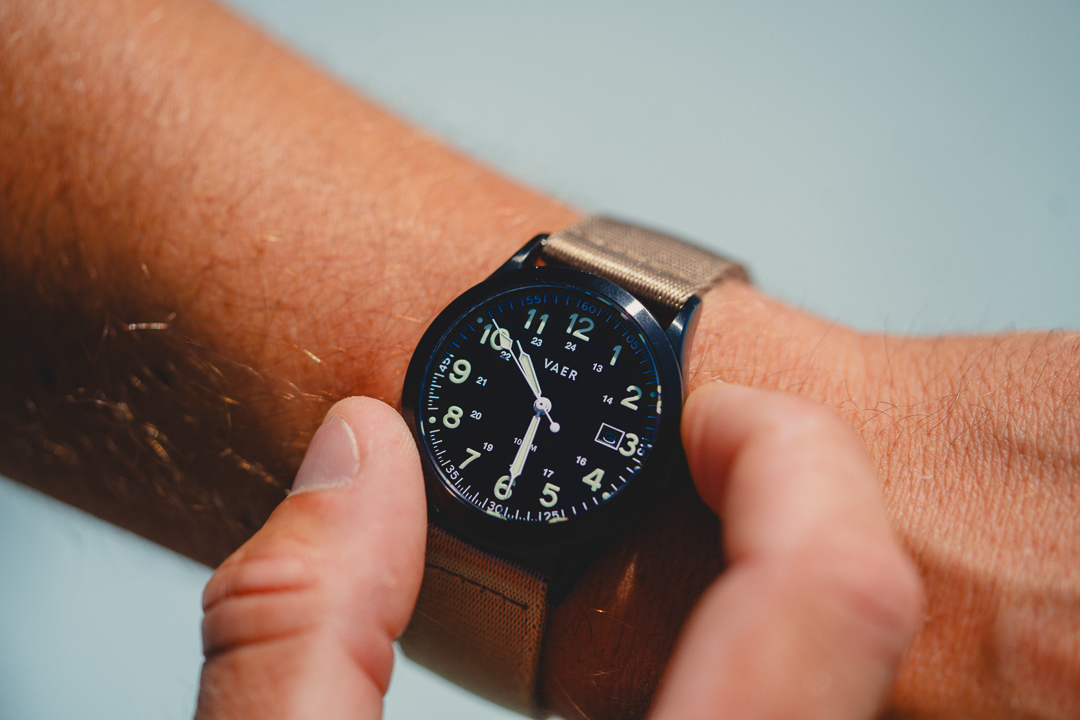
I have to give some props to the crown tube and positioning. It extends beyond the case in a manner reminiscent of early Black Bays from Tudor; I didn’t understand it with those watches, but as I found myself fiddling with the PCH in the Rover and at camp, I was consciously thankful for how that extra surface area made the crown easy to grip. Ditto on thankfulness in regards to the comfortable rubber strap, too; a 20mm tapering down to 18mm that is embossed with the Lōcī logo on both pieces, it is the exact feature that can benefit any watch out in the desert. The word I want to use to sum this all up? Tactility. You use the PCH without ever thinking too much about it, which is a quality with real value.

If the case and features are utilitarian in practice, the dial with its sunburst gradient and stepped center is an artistic foil. It doesn’t take much wrist time to realize that this dial is very dynamic under sunlight. Unlike the Big Sur and Monterey Bay, the Surfrider Beach doesn’t really activate with a roof over its head – you have to go outside to appreciate it. The color range varies not just widely, but wildly: white, tan, lilac, slight shades of blue, etc. Unfortunately, the dial does suffer from what I fear is true with the Dune White Ranger: with so much white in the gradient’s core, the logo and text have a tendency to wash out under heavy exposure. The PCH does have a remedy, however: the mirror polishing present on the handset and kit kat indices creates the contrast you need to tell time outdoors.

As I put all the ingredients together while staring at the PCH in my camping chair, I realize that while I never would have concocted this recipe myself, I’m supremely grateful that Trip did. It is a thought-provoking and memorable subversion in an exercise where I was fully sure of what I was looking for. Instead, I found desirable field watch qualities in a time keeper that is anything but. As is often the case with cameras, cars, and gear, the PCH cements a tried-and-true trope as my conclusion: the best watch for the job, in this case desert timekeeping, is the one you have on your wrist.
That’s it for watches today – daylight is waning, and I’m out of mental capacity to both take photos and produce content. Time to enjoy a beer, dinner, and fine company before an early bedtime.
Day Two: Sunday, 12/7

Despite the best efforts of a harvest moon casting its shadow over the valley and a thoroughly curious pack of coyotes, I sleep soundly through the night. It’s a lucky break – sleeping bags don’t typically come equipped with sleep numbers – and I am excited that my lifetime hit rate for a good night’s rest in a tent is now above zero percent.
Our herd has thinned considerably by 8:00 AM. Jeremy and Willy are gone before daylight; the latter has lost his appetite, and so they’ve understandably headed home for greener pastures. Jordan, Veer, and Shawn all have time-sensitive commitments, and so they too decide to hit the pavement in an effort to get home at a reasonable hour. After the dust has settled, only Team Amarveer in the Range Rover and Team Zach in the Xterra remain to tackle more of Joshua Tree.

Berdoo Canyon, today’s route and exit out of the park, is a group favorite. It’s just shy of Old Dale Road in length at 22 miles total, but the difficulty and the familiarity of the trail are in reversal – Amarveer expects it will take us 2-3 hours versus 4-5 for Old Dale. We’ll enter via Joshua Tree, conquer Berdoo, and exit through BLM lands back into the Coachella Valley where we started. Before leaving this morning, Shawn had warned us that parts of the road were closed a week prior due to serious mud. We elect to press on – the road is either open or closed, and we will find out regardless.
The initial step is a scenic, hour-long pleasure cruise to the trailhead. We pass by several well-known landmarks, but what I am keen to discuss and understand is the significant lack of Joshua Trees in the southern end of the park. Aside from one noticeable stretch of road, they simply don’t have a strong presence in this area. Between the three of us and Bill the dog, we come to the rough conclusion that the lower elevation is to blame for this acute lack of the park’s namesake foliage. Higher temps combined with poor seed dispersal limit their range – we simply won’t see as many below 3,000 feet above sea level. After the trip, it will dawn on me that I saw almost as many Joshua Trees on the way to Old Dale as I did in the park proper.


As is tradition, Berdoo Canyon starts with yet more sandy washboards – our first 30 minutes are spent casually traversing these roads. There’s a bit of incoming traffic both ways, and I get a quick crash course on hand signals and etiquette around who is expected to pull over so the opposite group can pass. Almost immediately upon the conclusion of this sandy stretch, we stumble into the reason why recovery equipment and friends are such essential features of the overlanding experience. A Tacoma has found itself immobilized – it is ostensibly the same model as Jordan’s truck, but the driver here evidently went hunting for mud in what appears to have been the entirely wrong gear.


Zach and Amarveer get to work. This is Zach’s first recovery, and he has elected to take the lead on ripping this Taco out of the mud. Shackles, a toolbox to dig out the necessary wrenches, and a recovery strap all make a guest appearance – it takes some light digging (luckily, no shovels required this time) to find a proper recovery point, but eventually the crew is set up for a hopefully successful attempt.


The moment of truth has arrived – a picture is worth a thousand words, and so I’ll point you to the gallery below for a play-by-play:


With a solid foot to the floor, the Xterra makes a good account of itself as the Tacoma lurches free from the mire. Triumph achieved in an energy-boosting moment: it’s a great milestone for Zach, relief for the formerly stranded Tacoma driver, and good karma for the whole crew. Everyone remarks that this went about as easily as we all could have hoped for – 15 minutes of work, no repeat attempts, all vehicles are mobile. Color me both impressed and happy to be behind the camera; it’s always a treat to see people put their knowledge and hard work on display, and I take pride in being privileged enough to document it.


Back on the road again. We’re officially in the canyon after another 20 minutes or so of additional navigation. Berdoo lives up to its mild-mannered reputation – it is a scenic canyon route with a Goldilocks sense of enclosure that makes things feel otherworldly but avoids the sensation of the walls closing in on you. All of the optional “fun” detours quickly pull back into the main trail, and except for one spot that causes Amarveer to laughingly do an impromptu inspection of his undercarriage (the chosen line was questionable), we are largely stress-free.


As we proceed further, I ask Amarveer and Katie about the subcultures of overlanding – what group of vehicle owners are the most fun, most snooty, etc. I’m equal parts interested in hot takes and stereotypes (they make our hobbies more fun, in all honesty). The only concrete answer I get is that the Jeep owners are a vibe – they are out here with the simple intent to roll over as many obstacles as possible. Imagine the irony when, as we are nearing the exit barely five minutes later, we are forced to pull to the side as a cavalcade of Jeeps roll through in the opposite direction.


As I snap some photos, these Jeep drivers are true to their billing; almost every single one has a mile-wide grin on their face. It’s a welcome glimpse into the community of overlanding from the perspective of a different group – grab your car, grab your friends, grab your tools, and hit the road. They don’t know us, and we don’t know them, but it seems likely that everybody out here subscribes to the same ethos: it can be more rewarding to go farther together instead of faster alone.
With the Jeeps gone, we quickly make it to the end of the trail and roll back into BLM lands (right through several shooting ranges hosting a variety of interesting participants). Joshua Tree is firmly in the rearview mirror, and only Palm Springs and Los Angeles remain beyond it. We say our farewells to Zach and Bella over the radio – they’re headed down to San Diego and are quickly diverting onto a different route – and now the group has officially and completely dispersed. The Range Rover is once again a solo act.

We trundle into Palm Springs before too long, casually judging at least one overlander with a payload problem on the way into town. As I had hoped, the Transalp is still faithfully waiting on a side street behind the Ace after two days of gallivanting through Joshua Tree. There was some small concern beforehand that I might not have a bike to come back to – luckily, no harm, no foul, and I will be able to make my way home under my own power. Not blind to the fact that the desert air can weigh heavily on the Transalp’s tortoise of a 600cc engine, I bid a brief thank you and goodbye to Amarveer and Katie before loading up the bike in ostensibly the same setup I rigged for the ride out from Venice.


One last photo and a brief moment to reflect on the trip after slipping my helmet on. I’m supremely grateful for several things: the opportunity to live in a place like Los Angeles, making friends with interesting people who can broaden my views, and experiencing nature in a way that I didn’t think was ever going to be accessible to me. The trip is a touchstone and a reminder that, if you put yourself out there and show some curiosity, the right souls will reciprocate your energy and literally bring you along for the ride.
Time to hit the road – I’ve got another three hours ahead of me and a spaghetti Sunday date at the Georgian to make by 5:00 PM, and it would appear that I am already late to the gas station. Cheers, all.

Leave a Reply