
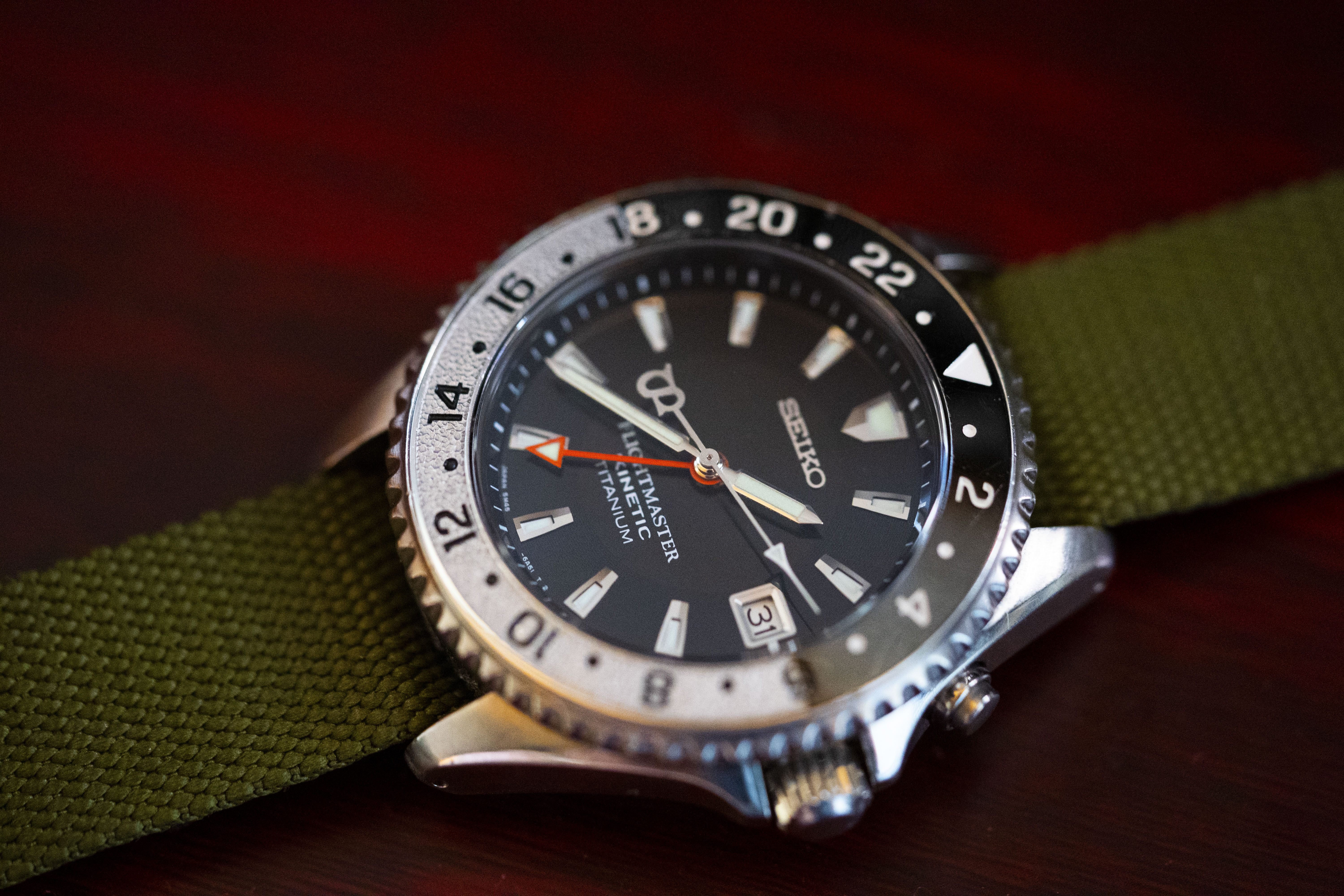
For all but the most diehard Seiko nerds, this particular reference is a complete unknown. In 1986, Japan’s premier watch company debuted what would eventually be known as their kinetic line, a new type of watch that bridged the gap between quartz and mechanical. The Seiko Flightmaster GMT is part of this unique lineage, and in my mind, is worth the energy it takes to actually find one.
ABOUT
In 1986, Seiko was already at the pinnacle of watch innovation, having personally instigated the Quartz Crisis decades prior. They had succeeded in taking Switzerland’s lunch money, but now that quartz was common, further advancement was necessary to keep Seiko’s competitive edge while also addressing environmental concerns about how many cheap, disposable watches were hitting the global market. Enter the introduction of Seiko’s ‘Automatic Generating Movement,’ or AGM, which swapped your regular ole’ battery for a rechargeable capacitor. With an attached rotor generating electricity via a coil block, AGM effectively became Seiko’s foil to the mechanical automatic movement.

Over the years since AGM (later changed to AGS and now aptly named Kinetic) became commercially available in 1988, Seiko has introduced a variety of models with functionality ranging from simple time-only offerings all the way to their modern kinetic perpetual calendar. A trio of field-oriented models were launched in the mid 90s under the auspices of Seiko’s Master collection; this group was comprised of the Landmaster, Scubamaster, and our rare bird in question, the Flightmaster GMT.

Of the three watches, only the Flightmaster GMT has a removable case back and easy access to change notoriously weak OEM capacitors. 5M45-movement versions have on the dial either “AGS” underneath the Seiko text, or “Kinetic” under the Flightmaster text. There is also a rarer version that has both a numbered chapter ring (this adds even more time zone functionality) and the trivially better 5M65 kinetic movement. It should be noted that both movements house a true GMT complication, meaning the local hour hand can be quickset when the crown is in the second position to make quick time zone adjustments.
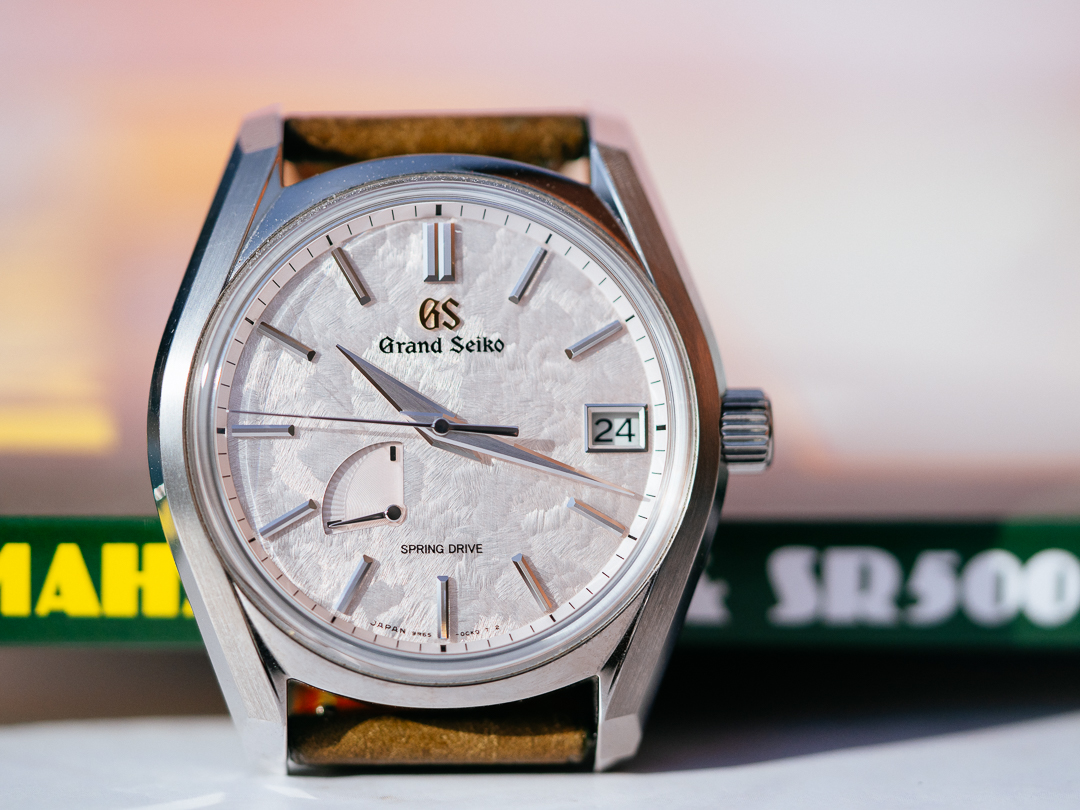
All versions of the Flightmaster GMT, as well as its siblings, use titanium as the case material. This is a very appropriate choice – there’s a certain sensibility to earthy titanium over steel when considering the ethos of a tool watch. I have seen more than one online commenter state that titanium’s light weight can make a watch feel cheap or toy-like. Having owned both Grand Seiko’s iconic Snowflake and this watch, experience tells me it is more situational than we think. Although titanium lines up with the theme of the Snowflake (hence its name), its Zaratsu polishing simultaneously suggests both a healthy fear of scratches and a watch that should have more heft to it. The Flightmaster GMT’s light weight and muted coloration is complimentary to its purpose and properly signals it is an on-the-go travel companion.
A quick additional note about the case – Seiko got it right putting this watch at 40mm. The drilled end lugs finalize our length at 48mm across, but they are visually a bit short and also slightly arc downwards in shape, giving the Flightmaster GMT a tailored fit that hugs the wrist. The thickness of the case is 13.5mm, but when your metal of choice is titanium, this height evaporates due to the watch being a featherweight. One minor gripe here – the lug width is 19mm. Annoying, I know. Would 20mm have been too much to ask for, Seiko?

The design of the Flightmaster GMT also includes a useful power reserve indicator, which requires activation via the 2 o’clock button above the crown. Wait until your second hand lines up with the 12 o’clock position (not required but helpful). As it crosses, press the 2 o’clock button and observe how far the second hand travels. A 5 second travel equals a reserve between 6 and 48 hours; conversely, a full 30 second sweep indicates more than 7 days (the watch has a maximum reserve of 12-14 without any recharging). The second hand should resume regular movement after the same amount of sweeping time has roughly elapsed. There are two intermediate reserve measurements denoted in the manual, which I will link to at the bottom of this post.
Nowadays, Seiko and Grand Seiko largely use a passive power reserve indicator present on the dial, ultimately reducing dial symmetry in favor of a less fussy case design. Today’s more modern layout probably gets it right when comparing the two approaches in isolation, but we are talking about a difference of almost thirty years in watch design. Putting the Flightmaster GMT’s layout in the context of 90s production, Seiko’s misfit still provides for very functional power reserve measurement.

When you first observe the Flightmaster GMT, I think it is easy to recall Rolex’s offerings and draw quick parallels. The similarities begin and end after you acknowledge the bi-color nature of the bezel, and the differences surface before you leave it with the unique hammered texture of the bottom half. I have never seen another hammered bezel watch (if you find one, please message me so I can purchase it) and it gets plenty of compliments from the local RedBar crew. The seconds hand with the curved ‘S’ anchoring the bottom adds a distinctly Seiko visual cue that differentiates it from the orange GMT hand, and the dial has a playful checkered pattern that reflects well in sunlight. The luminova has plenty of surface area along the hands and indices, so visibility at night is a breeze. Combine these elements together and the result is a watch with simultaneous high contrast and legibility.

Unfortunately, if you love this watch and want to buy one, there’s one major drawback – you cannot find it reliably on the internet. Anecdotal evidence suggests these were only sold in Japan, although I haven’t seen any specific JDM (“Japanese Domestic Market”) labeling. Examples pop up every couple months, usually via eBay or Chrono24, and are priced in the $700 – $1,100 context depending on overall condition. Personally, I paid towards the bottom of that range after finally finding a U.S.-located example. It is most definitely blue collar after traveling twenty plus years to find me – the upper half of the bezel is decently faded, and the case has absorbed several high-profile scratches. As you might suspect based on the tone of this post, I wouldn’t change anything about its condition.
At the end of the day, the Flightmaster GMT is a wonderful, well-proportioned product of 90s Seiko vintage that had entirely too short a production lifespan. I share Patrick Marlett’s sentiment that this is a prime candidate for a re-issue, perhaps even with a mechanical movement, and that it deserves a spot in Seiko’s current lineup. Given the release of Seiko’s new SSK caller-style GMTs, I think a re-issue would be out of left field but that won’t stop me from championing its return. In the meantime, I am more than happy to enjoy my personal watch. The Flightmaster GMT is labeled as a master of the skies, but it most definitely fits in as an ally on solid ground.
The Specs:
- Case Material: Titanium
- Crystal Material: Sapphire
- Features: True GMT Function (Jumping Local Hour), Power Reserve Indicator
- Movement: 5M45 Kinetic or 5M65 Kinetic
- Max. Power Reserve: 14 Days
- Screwdown Crown: Yes
- Bezel Movement: Bi-directional
- Water Resistance: 100 Meters
- Case Diameter: 40mm
- Lug-to-Lug: 48mm
- Lug Width: 19mm
- Thickness: 13.5mm
Click here for access to the 5M45 movement manual.



Leave a Reply