
About
Special thanks to Matt McDonough at Spirit of Time for loaning this watch.

I often think of Grand Seiko as a brand that delivers value by committee. The company’s expansive range of nature-themed wallet killers – the Snowflake, White Birch, and Shohei all come to mind – score so strongly on the quality-to-price scale that anyone not actively considering them is leaving value on the table at their own peril. It helps that the quality gap between the core catalogue’s floor and ceiling doesn’t feel miles apart, too; whether you are buying a Shohei secondhand for under $4,000 or a fresh White Birch at $9,800, GS’s timekeepers provide a reassuring level of consistency.
The flip side of this equation is that Grand Seiko lacks an accessible, iconic watch. You could read between the lines and say what I really mean is an iconic sport or tool watch, and I’d be reluctant to rebuff you; in the watch world, we often uphold the Speedmaster and Submariner as essentials for those with the means to obtain them. The Snowflake is probably GS’s best known challenger for a spot on the pantheon; it checks the box on being accessible and, in typical GS fashion, has a lights-out dial that makes Swiss competition look like dinner plates. There are, in turn, question marks around its wearability. Given that the Snowflake is only 20 years old, it may yet become the watch that lives rent-free in the psyche of both hardcore enthusiasts and casual players. For now, however, I hold the opinion that Grand Seiko lacks a fully established legend killer.

The Snowflake is a lovely watch; I owned one for a spell, and occasionally like to opine on its virtues and deficiencies over a cup of coffee. That tryst was over five years ago, however, and I haven’t really had the opportunity to appreciate Grand Seiko since then. Recently, I had the good fortune of recording an episode with Matt McDonough at Spirit of Time as a guest host. In the closing moments of an enthusiast hangout the following day, I saw a lovely pink Grand Seiko politely waiting its turn atop Matt’s watch roll. I bluntly asked, Matt kindly obliged, and now the Shunbun SBGA413 is central to my reevaluation of which watch should be spearheading Grand Seiko’s 21st-century momentum. Let’s get started.
Hana-Ikada

The Shunbun originally dropped as a U.S. domestic exclusive within Grand Seiko’s Seasons collection from 2019. That collection was comprised of four elegant sport watches that corresponded to Spring, Summer, Autumn, and Winter: the Shunbun, Rikka SBGH271, Shubun SBGH273, and Taisetsu SBGA415. The watches were united by exterior design, all making use of Grand Seiko’s historical 62GS case, but featured unique dial designs befitting their respective seasons. Movement and material were split down the middle: the Shunbun and Taisetsu were 9R65 Spring Drive watches in GS’s “High-Intensity Titanium,” while the Rikka and Shubun were 9S85 Hi-Beat Automatics in “Ever-Brilliant Stainless Steel.” While the initial U.S. limited-edition Shunbun was just that and is now discontinued, you can still buy a Shunbun; the SBGA443 is an effectively identical regular-production JDM version that is available overseas.
The Shunbun’s 62GS case is a historical design dating back to 1967, and it wears far more compactly than the on-paper dimensions would suggest. It has a diameter of 40mm that stretches out to 47mm lug-to-lug, with the watch’s overall height clocking in at 12.8mm. Everyone has different standards for what level of thickness is acceptable to them, and normally, anything approaching 13mm sounds a tiny horological klaxon in my head. The 62GS design completely disarmed my reservations; the lugs have multiple Zaratsu-polished facets that shave down their presence, and the case is sculpted with wide-sweeping bevels that run the horizon of the watch. Up top, the Shunbun sports a boxed sapphire crystal with an anti-reflective coating on the inner surface. A stamped and knurled screwdown crown is the final accessory, supporting the Shunbun’s stout 100 meters of water resistance.

In the most unexpected of ways, the 62GS case reminds me of a Speedmaster Professional if it were shrunk in the dryer. Sure, the lugs on this time-only watch aren’t exactly twisted, and the inset crown lacks the natural crown guards of the Speedy’s asymmetrical case shape, but the Shunbun’s contouring does a very Speedmaster-like job of reducing visual thickness. Ignorance is bliss, and we as watch enthusiasts love to be lied to by dishonest cases that fool us with their geometry. I’m very pleased with the way the case is shaped; Grand Seiko’s choice to chisel away and create something svelte is a relief for someone who spends a lot of time around Tudor-esque slab sides.
Grand Seiko’s second trick was the case material. The company chose to armor the Shunbun in its High-Intensity Titanium alloy, which is 30% lighter than stainless steel and anecdotally seems like an analogous competitor to Grade 5 in terms of scratch resistance and hardness. As a result, the Shunbun rejects both gravity and the coldness of steel in favor of a warm, stormy grey coloration. Recognizing that weightlessness is not universally celebrated, I personally find the Shunbun to be highly inviting on the wrist; as with all things in watches, your mileage may vary.


By visual comparison, the 62GS case is geometrically simpler than its 44GS sibling, which has buttered Grand Seiko’s dress watch bread for most of the modern era. After ample wrist time with the former and some brief experience with the latter over the years, the 44GS case feels like the more complex but coincidentally less organic choice. Its slanted bezel flanking the crystal and the additional facets on its long, winged lugs certainly give the wearer more to absorb. A more involved meal is not necessarily tastier; I personally find my preference for fluidity satisfied in the 62GS, where less beveling allows for a little more continuity in the lines of the case. The Shunbun’s flowing profile is very narrowly my second-favorite feature.

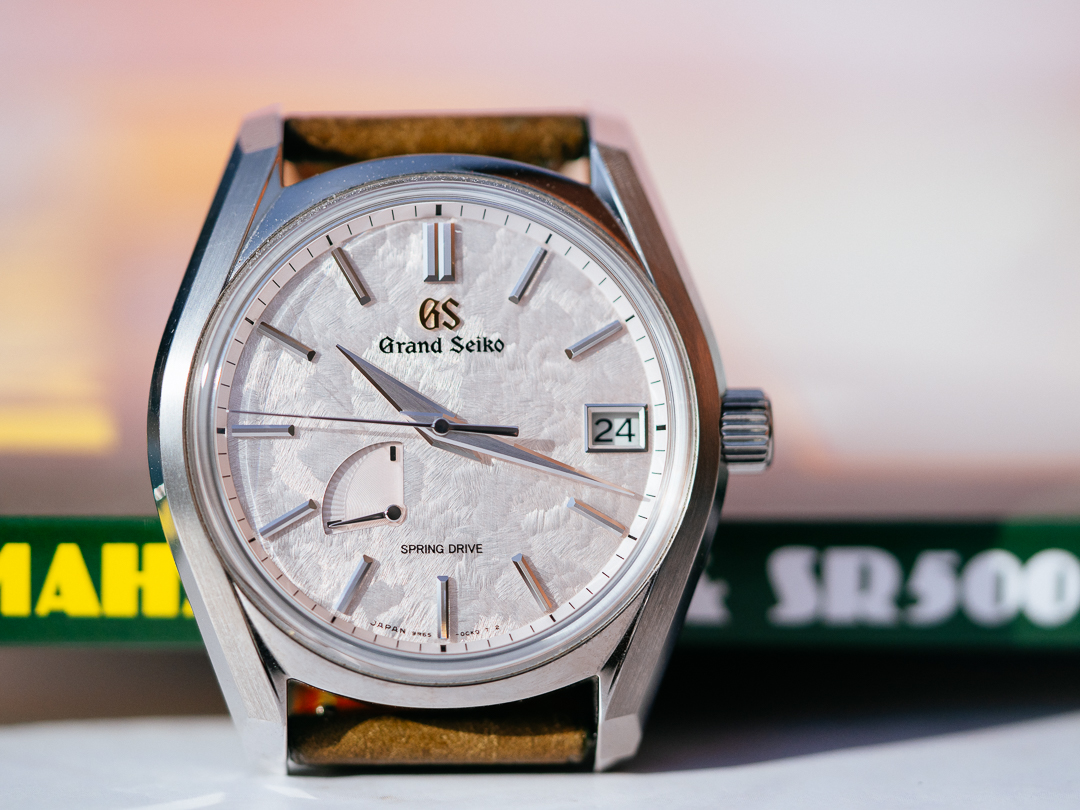
What’s the first? You already know the answer – it’s the dial. The Shunbun’s artistry is inspired by delicate Hana-Ikada, or pink cherry blossoms floating downriver in springtime. As with all Grand Seiko dials, the process is involved. To start, an artisan presses hand-engraved patterns onto a blank brass plate using a mold. A dial shape is cut from this base, after which silver plating and a clear coat are applied. Thin layers of subtle pink lacquer are added before the dial surface is cleaned up. From there, Grand Seiko carves out space for the power reserve indicator, center pinion, date window, and indices. The logo and indices are the last things to be applied after the dial has been polished one last time.


Hang it in the Louvre: the Shunbun’s dial has always been the most memorable of the Seasons collection, and for good reason. The pink dial has an opaline, almost Mother-of-Pearl-like quality that reinforces the organic qualities of the case, and it shimmers in a highly dynamic fashion thanks to the open sides of the box crystal. The Zaratsu-polished indices and Dauphine hands are a perfect complement; they bring out just the right amount of contrast to balance out the preordained haphazardness of the dial pattern. The rehaut doubles as a very simple chapter ring, featuring vertical hashes for the minutes that are functional but not fussy. Last but not least, dial text is minimal without feeling simplistic. You get Grand Seiko just south of the applied gold logo, Spring Drive, and a country-dial code line below six o’clock that effectively requires a loupe to read. That’s it. Everything feels very harmonious… as long as you don’t flip the watch over.

Just kidding, but still.
My list of Shunbun-shaped complaints is brief and contains but one damning tally: for the life of me, I cannot understand why Grand Seiko insists on obscuring their sapphire display casebacks with the company’s lion medallion logo. You would think a company so confident in its proprietary movement technology would also be confident enough to let buyers see its proprietary movement technology; alas, some egghead decided that laser-etching a billboard of the GS lion on the caseback was an aesthetic enhancement. Recognizing this is a historical tie-in to Grand Seiko’s original watch that dates back to 1960, I still think the past need not be invoked on display casebacks for any of Grand Seiko’s models. Less is more, Japan. No one is going to forget that the Shunbun is a Grand Seiko because you didn’t opaquely paper over the southern porthole.

Both the 413 and 443 iterations of the Shunbun come with five-link bracelets. These bracelets are made out of High-Intensity Titanium, like the watch heads, and feature polishing on the intermediate links that straddle the center section. They are also pin-and-collar style, which is apparently common to GS’s titanium watches and something I was surprised to find instead of a screw-link system. It isn’t a choice without merit, just a choice with trade-offs – you add both security and tediousness when it comes to adjusting. The Shunbun bracelet uses a three-fold clasp with a push-button release. Disappointingly, it does not have any micro-adjustment capabilities. Public sentiment on GS bracelets is not unwarranted: the specs make it feel like an afterthought and a poor pairing for such a well-thought-out watch.
Keeping all of that in mind, I’m lucky because I never wear watches on their OEM bracelet anyway, and I think the Shunbun is an absolute strap monster if provided with the right material for the job. For this article, I pulled this green, waxy Delugs strap from the arsenal that I would previously use on my Tudor Pelagos 39 from time to time. It tapers slightly more than the bracelet (16mm vs 18mm on the latter) and has that perfect earthy shade to complement the Shunbun’s cherry blossom hue. Just remember when you pick out a strap that the Shunbun has 21mm lugs: mind the gap.


Something quintessentially Grand Seiko that always generates conversation is the power reserve indicator sitting at seven to eight o’clock on the dial. Seemingly simple to interpret as a measurement of the Shunbun’s 72-hour power reserve, it is alas not the most intuitive horological fuel gauge – when I first inspected the Shunbun, I forgot that its mainspring is fully wound when the indicator is pointing at the bottom, where the fan-shaped pattern is widest, as opposed to the top. If nothing else, it serves as a polite invitation to engage in the only tactile activity (i.e., winding) that the Shunbun offers as a bezel-less watch.

I have but two words to describe the quantification of power as executed by Grand Seiko: memorably imbalanced. I fear I am to be diagnosed with a case of Stockholm Syndrome; I love the feature in the same way that I love Rolex’s equally divisive cyclops magnification window. Grand Seiko didn’t invent the power reserve indicator – that honor longs to Abraham-Louis Breguet – but I would say they have done as good a job as any company in this modern age of watchmaking in taking a complication and making it a signature identifier of their brand. At the same time, the presence of the indicator does create an imbalanced dial. The magnitude of this annoyance is small for me, but I recognize that it may cause seismic levels of discomfort in the eyes of others. As a result, I wish Grand Seiko would offer the current 443 model in both normal and reserve-less configurations. It probably isn’t a commercially reasonable enterprise – not cutting into the dial feels like a time and cost-saving measure, but the Shunbun’s addressable market is likely too small to support a second regular-production version. One can only dream.

That power reserve indicator isn’t just tied to any old movement; as I have mentioned a few times now, the Shunbun is a 9R65-equipped Spring Drive watch. The Spring Drive has long been Grand Seiko’s ace-in-the-hole, mating a mainspring, gear train, and glide wheel with the company’s patented Tri-Synchro regulator. That last bit replaces the escapement found in mechanical watches; using an integrated circuit, the regulator detects the speed of the movement’s glide wheel via a quartz crystal and adjusts the wheel’s spinning speed appropriately using an electromagnetic brake. The result? Quartz-like precision – the 9R65 is accurate to +/- 15 seconds per month or +/-1 second per day – and an absolutely mesmerizing smooth sweep for the second hand.
The Spring Drive is Grand Seiko’s claim to movement fame; their HAQ and pure mechanical movements are also excellent, but if you are a first-time buyer of the brand, Spring Drive is the place to start. These movements are exceptionally durable; there’s no contact, unlike with a traditional lever escapement (the electromagnetic brake doesn’t touch the glide wheel), and the quartz crystal oscillator is far less vulnerable to significant shocks or impacts than a balance wheel. And because of that quartz oscillator, you can count on consistent accuracy right up until the mainspring fully unwinds – there is no loss of torque, so accuracy will not degrade as the Spring Drive movement loses power. An average watchmaker might not have experience with Spring Drive technology, but the 9R65 is robust enough to stand on its own merits.
A Case For Spring Year-Round

After an extended taste test, I find the Shunbun to be a cocktail of disagreeable elements that have come together to form the perfect recipe. The elegance of its spring dial and Zaratsu polishing suggests the Shunbun should be a guest star for special occasions, vacations, or even a spirited Sunday drive; on the other hand, the sporty 62GS case, forged in titanium and standing tall at 12.8mm, clearly pushes it out of traditional dress-watch territory. Square peg, round holes – the Shunbun exists in the middle of the Venn diagram. In my estimate, its greatest strength likely lies in the ability to competently exist as one of the prettier watches in both playgrounds.

Unfortunately, pretty is what Grand Seiko does best – they put out a lot of nature-themed dials. It’s their shtick, and it is at least somewhat comparable to Omega’s corporate strategy up until the end of the teens, when they were producing as many limited edition Speedmasters as the public could handle. In the most highfalutin metaphor I can use, one that will leave all but those who live in SoCal snickering with eye-rolling contempt, it’s a bit like sunsets in Los Angeles – if there’s a beautiful sunset every evening, what is the value of a sunset? Grand Seiko has harnessed Mother Nature’s Nipponese qualities with unforgiving corporate fervor, and I think it has produced a touch of ambivalence in some enthusiasts for the brand’s dial work.
Up until my time with the Shunbun, I was guilty as part of that party. One brand can’t be something meaningful to everyone, but I subconsciously put on the blinders after my Snowflake experience and was content to let the brand exist outside my narrow scope of interests. The Shunbun has done a wonderful job of re-opening my eyes to a whole group of watches that I had mentally closed off. In a sea of Grand Seiko dials inspired by nature, I think there’s something special to a Grand Seiko dial inspired by nature that you (in this case, me) specifically latch on to as memorable.

The Snowflake put modern Grand Seiko on the map. I believe that it is the Shunbun in ref. 443 garb, however, that will eventually grow to be a standard bearer for the brand. The advantage of the Shunbun is the high wearability quotient of the 62GS case; the Snowflake has an elite dial, but the Shunbun has both an elite dial and a case worthy of putting it on display. At the same time, the other Seasons watches had the 62GS case and strong dials, but perhaps not ones that captured aesthetic lightning in the same way as the Shunbun. And while many have noted the Shunbun’s pink shading can be hard to coax out of hiding (just look at my photography to confirm their position), I would argue hunting for that pinkish hue in various lighting conditions is actually part of the fun.
It would probably take another update by Grand Seiko to bring my dream of Shunbun pantheon status to fruition. Reflective conjecture is in order. Would it take a re-release in stainless steel? Probably – titanium is core to the Shunbun’s bone structure, but it is a polarizing case material. Would that new version need Lume? Also likely yes, but that would not improve a near-perfect hand and indices combination. I’m certain that such hypothetical changes would make the Shunbun inalienably disagreeable to its own identity. In the end, I am convinced that the peculiar specifics of the Shunbun’s design are what make it, at least to me, a perfect timekeeper and an icon in its own right. Well done, Grand Seiko.
—
For more information about Grand Seiko and the Shunbun, please visit their website.


Leave a Reply