
About
It is a weird thing to ask the question “is this watch mine?” The conclusion is foregone if you buy it new; you are the original owner, full stop. If your purchase is made secondhand, you might pause to consider its provenance every once in a blue moon. But what if your watch passes to you from friends or family and you have knowledge of the wrist that racked up the original mileage? That watch isn’t yours. How could it ever be?
Properly maintained and serviced, a mechanical watch is a durable talisman; it will probably outlive its first, second, and fourteenth owner. Maybe there is merit to the idea that we are only temporary caretakers until a watch begins its next chapter. Maybe watches don’t live lives at all because they’re inanimate and I’m just a sappy romantic. Regardless of the truth, I find myself pondering the topic because of the orange-faced Doxa dive watch sitting on my wrist.


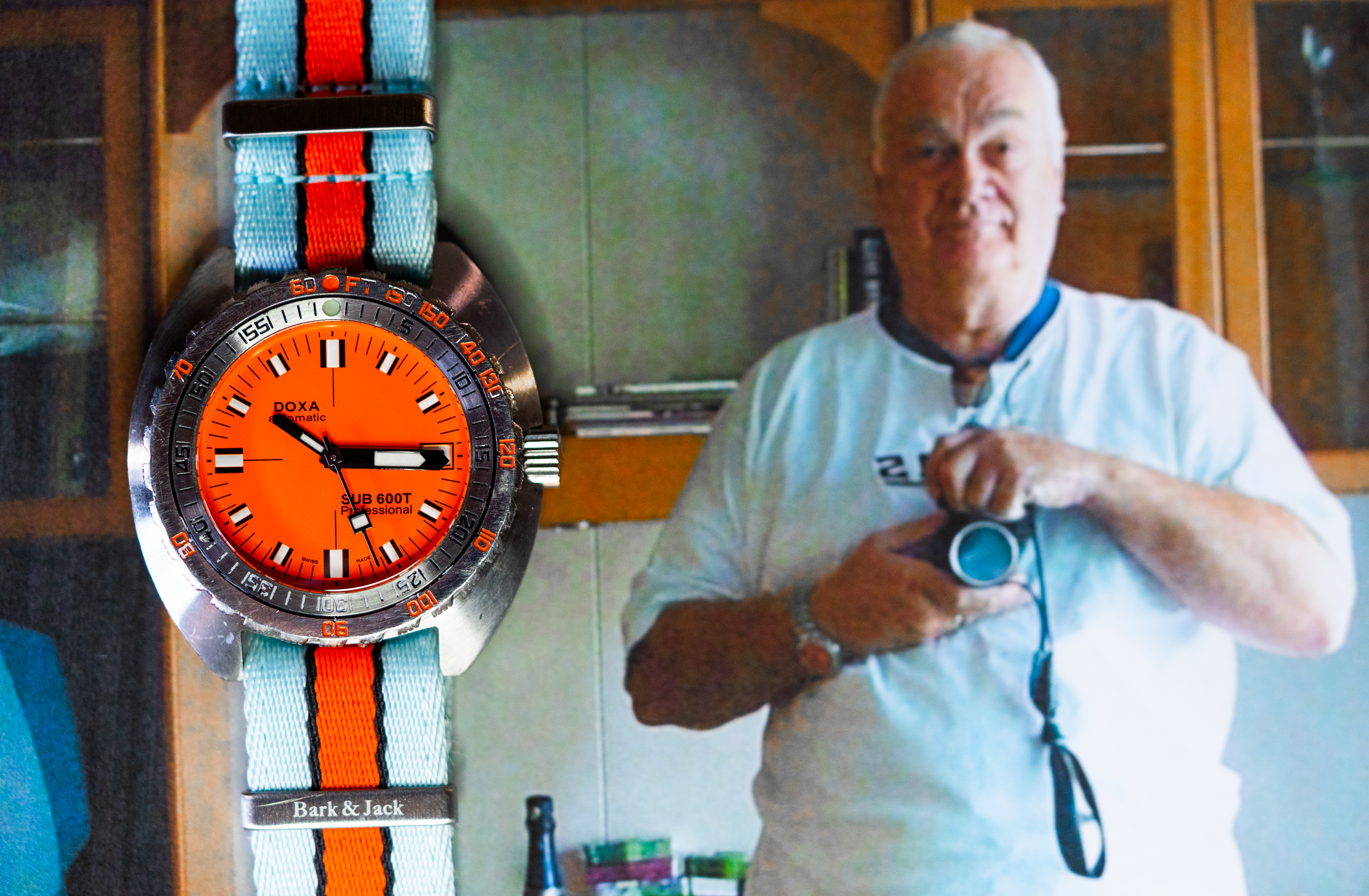
This Doxa, a Sub 600T Professional ‘Clive Cussler,’ isn’t my watch. It never will be. It belonged to and is identified with a man named Ron Ward, who owned this watch for almost twenty years, was beloved by many, and passed away nearly four years ago on Father’s Day, June 2021. This recounting of his story and Doxa’s small connection to it is everything I love about watches. I hope you enjoy reading it as much as I enjoyed writing it.

Ron Ward
Ron was Missouri made; he was born in Saint Charles in 1935, and lived there as well as Saint Louis and Kansas City at various points in his life. He worked at McDonnell Aircraft for a year out of high school, precursor to McDonnell Douglas (creator of the F-4 Phantom for any aviation nerds out there). In September 1953, Ron joined the Army and was sent to West Germany as a lineman. Climbing trees isn’t for everyone, however, and a little white lie about testing well in Morse Code had him switched to radio until he was honorably discharged in August of 1955.

Art was Ron’s wheelhouse, and he started this creative pursuit early with his education. Post-army, Ron went to college on the G.I. bill and got a B.S. in Art Education at Southeast Missouri State. Buckle up, as our timeline now compresses and accelerates rapidly: after college, Ron took a job at Coolidge Junior High in Granite City School District as an art teacher. He began teaching art and did so in the same classroom every day for 26 years. That’s right: one room, around 5,000 days (using modern assumptions for a calendar school year). I can’t even wear one watch without changing it between breakfast and dinner.

In the mid-80s, Ron set up a computer program designed for special education kids for the school district and eventually became their IT director. He made himself indispensable enough at Coolidge to be able to retire, come back for more money, and then repeat the cycle a few more times through 1995. In 2006, Ron called his long career a wrap after having worked eight more years in IT at an elementary school.


Ron’s artistry didn’t subside despite his professional shift to computer education, and he was renowned for both his affinity for pottery and activity at church (where he often combined these skills during “pot talk” sermons, shaping clay while preaching). It was a perfect venue for Ron to display his showmanship, despite his reputation as a man with a knack for personal connection. Along the way, he married, got divorced, and then met a woman at church named Lynn who would become everything to him. Ron and Lynn called it a date and married in 1977. They spent their days mostly living at the lake house they built in Illinois, which eventually became a special place for the family tree to watch their acorns grow.


Prior to their marriage, Lynn had two children; one of these just so happens to be David Burch, my partner Sarah’s father. He describes his relationship with Ron as impressionable; the latter adopted both David and his sister and took them in as his own. David remembers him explicitly as a man who worked a hundred jobs with a story for each and the experience to match. “Every single job you have will make you better at the next one,” David cites on Ron’s philosophy. “Be willing to try something without instructions.”
Sarah visualizes Ron as the man with the camera, entirely devoted to loving on her grandma and capturing their life together. She also remembers him in a different way than David that is just as fond: patriarchal and connected to the heartbeat of his family. “Ron made everyone who spoke to him feel special. He had a unique way of making you feel heard.”
Dirk’s Desert, Dirk’s Dune
I love a good action movie with the fam’ during the holidays. Theater or at home is irrelevant; I’ll always jump on an hour forty-five of underbaked plotlines and gratuitous explosions. My easiest example is Die Hard being the all-American Christmas movie (don’t argue with me here, I can’t be swayed). There’s just something inherently wholesome about the crew stuffing their face with snacks while Hans Gruber falls to his doom from Nakatomi Plaza. Bear with me on this tangent: I promise there’s a point.
One of Ron’s favorite things (aside from Lynn, his family, art, and community) was the books of action novelist Clive Cussler. Cussler is best known for his series following the adventures of Dirk Pitt, a decorated Vietnam veteran who works for and eventually leads the federal National Underwater and Marine Agency (or “NUMA”). Cussler’s signature hero is known for exploring shipwrecks as much as he is saving the world from global devastation, both feats he usually achieves at least once per expedition.
Life imitates art: NUMA is a real non-profit organization, albeit dedicated in our world to the archaeological survey and conservation of shipwrecks instead of fighting crime. Cussler initially conceived of the federal ocean defender for his books before founding it in 1979. He led NUMA until his death in 2020, and it continues to be primarily funded by royalties from his novels. Cussler’s son, Dirk (ring a bell?) is NUMA’s current president and continues to write Pitt novels in his stead.

Image: Paramount
Cussler characterizes Mr. Pitt as a swashbuckling Bond with dashes of Indiana Jones and Jacques Cousteau mixed in. Cussler partially wrote his protagonist as a personal reflection of his own interests and qualities; Dirk is a pilot just like Cussler and maintains a serious collection of classic cars, even using some of Cussler’s depending on the book. He carries his father’s Colt .45 1911 as his chosen sidearm. Even tequila is specific; Dirk mixes or drinks it straight depending on its quality (or lack thereof).

Dirk’s car collection isn’t the only thing in his universe of particulars that pulls inspiration from Cussler’s life. In the very late 60s to early 70s, Cussler worked as a clerk at Ron Merker’s Aquatic Center in Newport Beach while searching for an agency to publish his first book, Pacific Vortex! (which ended up being published sixth in 1983). When business was slow and he wasn’t acting as the shop’s dive master in San Catalina, Cussler would write on a card table behind the counter. When Cussler left in 1970 with a draft of The Mediterranean Caper in hand, Merker and his fellow shop co-owners chose to commemorate their time together by gifting him with a dive watch of his choice. Cussler chose Doxa’s Sub 300T in “Professional” orange, which was considered the watch in the diving community at the time. It left such an impression on Cussler that he often wrote Dirk as referencing an orange-faced Doxa; the Sub 300T Pro is now known as an iconic piece of Dirk’s kit.

This is where my earlier rant about family fun ties in. Heard of Sahara? It’s the definition of a cheesy action flick from the early 2000s and the second (as well as last time) Dirk Pitt has ever graced the silver screen. Matthew McConaughey, Steve Zahn and Penelope Cruz essentially go on vacation in order to locate the hidden treasure of a lost Civil War-era Ironclad buried beneath the Saharan sands. The movie is based on Cussler’s novel of the same name, which was originally published over a decade prior in 1992.
Sahara unfortunately sank as a box office dud ($119m gross versus $160m in production costs), but it wasn’t for a lack of marketing on Paramount’s part. Important to our story is that Doxa, Paramount and Cussler all worked together in some capacity to produce new limited editions of two historical references, the 600T and 750T, in advance of the film. The former was the first and dropped in November 2003 right as production of Sahara began. There are other colorways, two orange dials and production numbers to sift through – more on this later.


Ads for the 600T Professional “Dirk Pitt” and 750T Professional.
Ron’s total appreciation of all things Cussler was very evident to David, who embarked on a shopping mission when he learned of the Doxa-Cussler collaborations being released around the time of the film. The watch he settled on? The 600T Professional. “Back in the early 2000s I went searching from store to store for orange Doxas, but only the Cussler version,” David recalls. “I finally found one and gave it to Ron, who loved it. He just wanted to be in character.”


As it stands today, Sahara remains both a small Burch family tradition and a memory from a well that they all love to draw from. “Everyone can hear the name and go, oh yeah, let’s watch that,” Sarah says with a smile. “It’s definitely a comfort movie for me.” Even though Ron has been gone for a few years now, his adoration of Cussler’s stories remain imprinted upon the Burch family.
The Sub 600T Professional

Doxa has a special place in the holy pantheon of dive watch brands, even if the 300T was introduced many years after equally legendary contemporaries like the Rolex Submariner and Blancpain Fifty Fathoms. There are several distinct periods of Doxa with gaps in-between: the original independent company, Synchron, Aubry Freres, and modern Doxa split into the Rick Marei and post-Marei eras. The one thing that has remained consistent in this sea of corporate change is the design language: you always know a Doxa when you see one, and that is due in no small part to the 300T.

It’s hard to talk about the 600T without a foreword on its predecessor. The original Sub 300 was tested by Jacques Cousteau (inventor of the Aqua-Lung) and the U.S. Divers Company in 1967, who distributed the watch for commercial use. The 300 was eventually released in 1968 after some design changes as the Sub 300T “Conquistador” and set precedence for almost every Doxa watch that has followed. It has all the hallmarks of a great dive watch: sturdy steel construction, a bright dial color, different sized hands to draw emphasis to the minute track, and strong water resistance of 1,200 meters (beginning a confusing trend of naming issues). Most importantly, it was the first publicly sold dive watch to feature both a unidirectional bezel tailor-made for reascending without the need to decompress and a helium escape valve (“HEV,” itself particularly useful for saturation diving).


The Quartz Crisis proved difficult for Doxa, which unfortunately shuttered its North American presence not long after Aubry Freres SA bought the brand in 1978 (although it continued to operate in Europe). In 1997, the Swiss Jenny family acquired Doxa and partnered with Rick Marei, the godfather of modern Doxa, to help them market the new watches via e-commerce. The arrival of fresh 300Ts in 2002 signaled Doxa’s reemergence. These 300Ts were markedly different from the original due to an enlarged case shape and a host of other non-traditional changes; the new design ultimately proved unpopular.

Image: Dr. Peter McClean Millar
Cussler’s personal history with Doxa and his consistent use of Doxa as Dirk’s watch of choice positioned him well for collaborations with the company. When Doxa brought back the 300T’s original design in the form of the 600T as a result of customer feedback, the very first Professional model was dedicated to Cussler as a limited edition.

I’m keen to quickly clarify a bit of reference history. The name “600T” is most commonly associated with an angular quartz design sporting an elapsed timing bezel and four o’clock crown from the Aubry Freres-era. The blocky shape of the 600T evokes the Ironclad in Sahara (which is a fitting case name if the watch community could only rally around my genius). Modern Doxa brought the Aubry 600T back in late 2021; they refreshed it with a no-decompression bezel, updated bracelet and reticle indices found on some original Aubry 600Ts. The 2003-2005 600T is thus a pretender to its own name but also the true inheritor of the original 300T’s design.


Two Searambler 600Ts, one vintage and one modern. Image: Analog:Shift, Doxa
Doxa made two dial variations of the Cussler 600T, the “Professional” and the “Dirk Pitt;” the latter dropped as part of marketing for Sahara in 2005. Both are technically Professionals given their orange coloring, and McConaughey at least wore the Professional dialed version during filming. The Pro is stealthy; the only mention of Cussler is the engraved caseback text, which surrounds a neat medal insert engraved with the Jenny family’s fish logo (something the 750T version lacks). The latter is far more conspicuous, stating Pitt’s name where “Professional” would have been, and only mentions Sahara on the caseback. Doxa also did two non-orange 600Ts in a pair of other Doxa colorways, “Sharkhunter” (black) and “Divingstar” (yellow).

Based on recent discussions with Doctor Millar, production numbers vary wildly. There were 3,000 total units intended for the 600T run, but as soon as the 750T started production, production of the 600T apparently ceased. The Professional dial is by far the most common of the various dial colors; Ron’s particular watch is numbered as 0294. The Dirk Pitt dial was severely limited in scope; 70 of these were made at best. Don’t think you’ll get any luckier if you go hunting for the Sharkhunter or Divingstar (100 units for the latter). Given Doxa was early in its current life cycle, it makes sense to me that the Professional was given the largest production mandate. Regardless, all four watches are exceedingly difficult (bordering on nigh impossible) to locate and obtain.


The 600T closely follows if not downright copies the physical attributes of the original 300T. The movement sits in a battle tank of a tonneau case; the case diameter is 42mm, but the overall lug-to-lug is only 45mm and the height is a squat 13mm. The lugs are short (with a very pleasant 20mm distance between them) and stubby, and the sawtooth bezel is so inset it doesn’t even touch the circumference of the case. Those features in coordination with that short 45mm wingspan make the 600T a stable pancake on wrist that wears smaller than its dimensions would suggest.
The dial is also a very close copy of the original 300T minus perhaps the missing U.S. Divers logo; it is bright orange, a far more vibrant color than the shade used on the 2002 reissue, with printed indices. The “T” in both watch names formerly stood for Tritium, a radioactive material once commonly used for lighting the indices of watches. Despite its superiority in duration and brightness, it was eventually replaced by a modern, now widespread solution in Super Luminova (which is photoluminescent and requires light first to glow). The T thus now stands for “Taucher,” or Diver in German. The crystal above is sapphire with anti-reflective, scratch-resistant coating and has a slight dome to it; a very minute detail, but one that I prefer over the throwback box crystal on modern 300s that mimics the looks of the original 1967 Sub.

As I mentioned before, the no-decompression bezel may arguably be the most important part of this watch. Doxa is famous for equipping its watches with the “no-deco” bezel, and the 600T is no exception. The no-deco bezel summarizes the U.S. Navy dive tables, which state time limits for given depth ratings without needing to make decompression stops during a return ascent. This unidirectional bezel is split into two layers; the depth ratings are in orange on the outer ring, while the corresponding time at each depth is in black on the inner ring. You set the 60-minute pip to match your minute hand right before beginning your dive. If as an example your final target depth was 120 feet and you reached it, then your no-decompression limit would be 15 minutes.

The bezel’s sawtooth edge effectively makes the 600T a grippy 60-click fidget spinner, and the screw-down crown (engraved with the Jenny fish like the caseback) is no less material in terms of the grooves. There isn’t much play in either and the tolerances feel good, but both surfaces are very sharp; I’ve never owned a watch where the crown in particular was so rough to the touch. Doxa sells at a certain price point, and it naturally shows in the finishing when compared to more premium brands like Rolex or Omega. I’m sure this is an area that Doxa has iterated upon with newer models.
Doxa is a brand with a utilitarian ethos and has always used third-party movements, opting to source engines for their watches instead of developing their own. It is unsurprising then that a workhorse brand opted for perhaps the most legendary (and most copied) workhorse of all time in the ETA 2824-2. The 2824 has been around since 1982 and the “-2” denotes this is a second generation version; it beats at a fairly standard 28,800 vibrations per hour and carries a power reserve of 38 hours. I don’t know what grade 2824-2 the 600T carries, but it is keeping time well inside +/- 10 seconds per day.
It always feels inane bringing up a dive watch’s water resistance; the rating is critical to evaluating its efficacy, but no one uses them for diving anymore. The 600T is rated for, you guessed it, 600 meters; this equates to roughly 1,968 feet. You let me know the next time you’re headed below five feet in the swimming pool. Jokes aside, it is good to know the 600T gives an incredible (but also incredibly useless) margin for error around dive depth. One has to think that Cousteau would still be proud of modern Doxa’s capabilities if he were still alive today.
If I have to go on record using just one word to describe the 600T, I am calling it robust. It feels well-built and reliable; I’m not saying you should buy a 600T and start to abuse it (assuming you can even find one), but I am saying you can be confident in its abilities to withstand punishment. The odds are slim that Ron’s watch will go on a dive anytime soon. That being said, I will happily trust it to do just about everything else in the meantime.
What’s In A Watch
I don’t think Ron was ever a true watch nerd; if David hadn’t given him this Doxa, he might very well have gone another twenty years without wearing a watch at all. That’s not how the story turned out though, and based on the condition, it is readily apparent to me that Ron probably shared (at least subconsciously) my general approach for not treating watches as holy objects. To put it bluntly, he used the crap out of his 600T. Working with his hands and traveling the globe seem to have been one in the same.

Ron’s case tells the story. It contains divots and markings aplenty along the flanks and lugs. The bezel bore the brunt of Ron’s affection; you can’t reflect light across the polishing at any angle without seeing a web of scratches come to life. Multiple numerals have lost their paint, and I even had a small strip peel off “25” on the inner ring just before photographing began. Removing the bracelet was a task all on its own; once I finally succeeded, I realized my difficulty was because the spring bars were torqued beyond recognition.
When I first received Ron’s watch, it was caked end to end in potter’s clay. I’d be lying if I didn’t feel at least a little weird cleaning it off; it had come into David’s possession directly in the condition Ron had left it, slid into a desk for four years, and then come to me as if Ron had been wearing it yesterday. I said something earlier to the effect of “if you knew who had it before, it isn’t yours” and I stand by that. I own it, I wear, and it really doesn’t feel like mine. Regardless, I find myself attached and very protective of a watch for the first time in awhile. Losing my Pepsi ref. 16710, the watch I consider to be quintessentially “me,” would be far less devastating compared to misplacing this Doxa for a day.

As watch enthusiasts, we spend a lot of time observing and learning about watches from others. Every now and again you meet someone with a story about “the watch,” an heirloom from the preceding generation that is special for reasons equal parts silly and sentimental. You can ooh and aah, but you can’t quite appreciate its emotional significance to them unless you are fortunate enough to experience it yourself. I didn’t know Ron, and he only exists in stories for me. This watch certainly wasn’t his be-all, end-all by any stretch. But those stories come from the memories of the people who cherished him, and this watch was appreciated by him for the connection it represented to something he enjoyed deeply. I’m very excited to keep it ticking, traveling and close by the family who loved him best. Cheers.

—
Special thanks to Dr. Peter McClean Millar, for without his dedication to Doxa and extensive research, much of the company’s history would likely have slipped into obscurity by now. I can’t physically share his books (which have proven indispensable), but I can digitally share his website (which has also proven indispensable). Here’s to you, doc.
Technical Information:
- Case Material: Stainless steel
- Crystal: Sapphire with scratch-resistant, anti-reflective coating
- Movement: ETA 2824-2
- Power Reserve: 38 hours
- Caseback: Sealed
- Screwdown Crown: Yes
- Bezel Movement: Unidirectional
- Water Resistance: 600 meters (1,968 feet)
- Case Diameter: 42mm
- Lug-to-Lug: 45mm
- Lug Width: 20mm
- Thickness: 13mm
Update, 5/13/25: this article has been refreshed for discussions with Doctor Peter Millar. It will continue to be revised as new information becomes available on the 600T.



Leave a Reply