
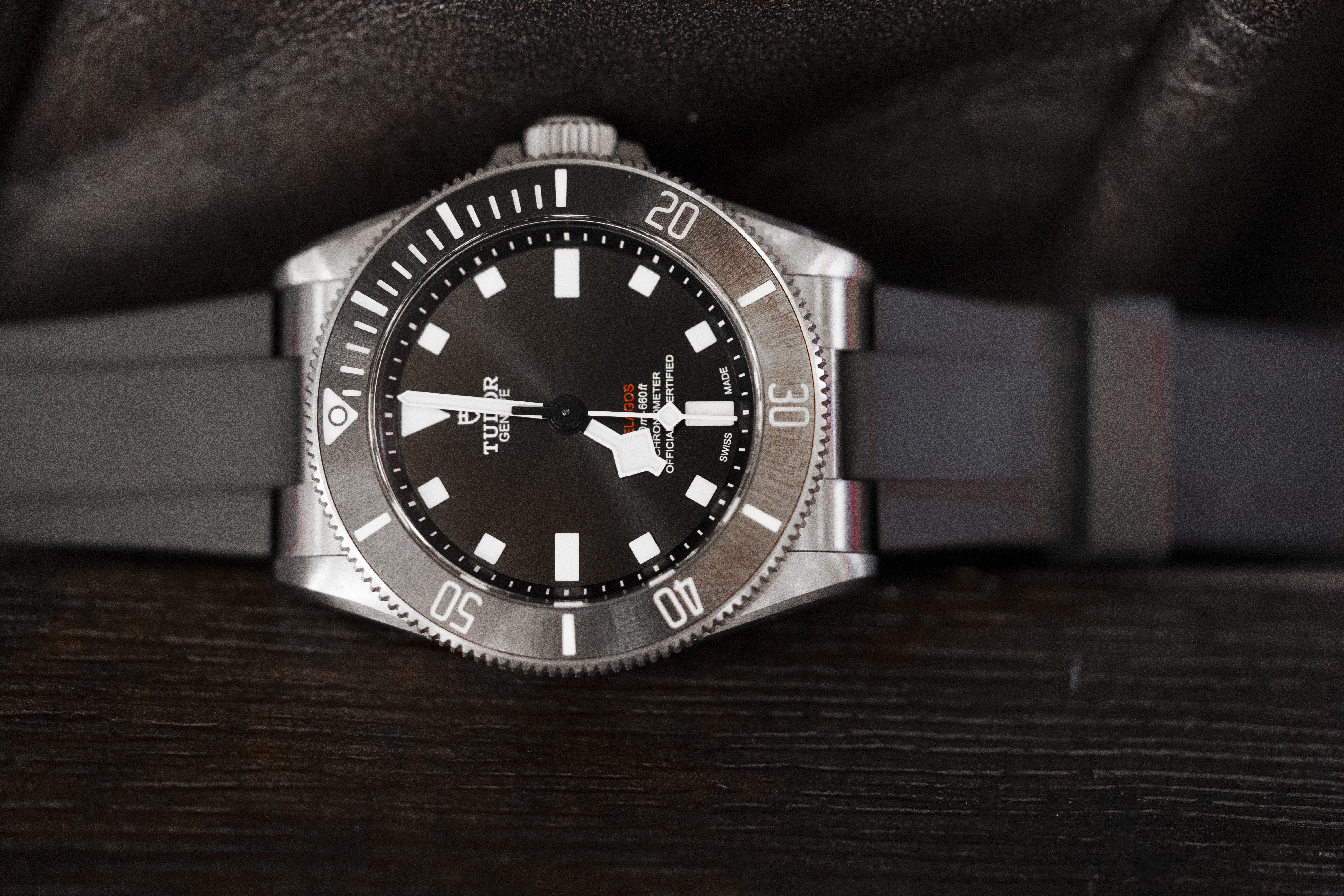
After an extended sabbatical, I come bearing gifts in the form of a watch review. Look upon ye lackluster time telling capabilities and despair – we have the Tudor Pelagos 39, Tudor’s darling everyday diver, in the house for an inspection. I have thoughts and you have eyes, so let’s get to it.
Okay, I’m back from picking up the milk and a pack of cigarettes. I did tell you I was going to come back, didn’t I? Right?
I do promise to stick around this time. My absence was motivated by equal parts good and bad.
The good: I have been plying my talents in motorcycle land. If you aren’t familiar yet, please visit Bonus Family Garage and read about all of the wonderful characters we’ve been interviewing in Atlanta’s motorcycling community. I was also working as a host team member for Atlanta’s edition of Distinguished Gentleman’s Ride, which culminated on Sunday May 21. Atlanta raised $70,000 as part of a global fundraising effort that clocked an astounding $7.1M overall. To top it off, I’ve got another creative media project in the works. More on that in July.
The bad: it has been a minute since I even wrote about motorcycles. I consider myself a peerless procrastinator, and yet the underachiever in me strives to ever-lazier heights. I tend to start new endeavors at 200%, invariably losing focus after a few months before launching myself into the next great crusade. Predictably, the watch blog became the latest casualty of this pattern. I’m treating this post as a breakout: perhaps if the fire is tended to properly instead of with a large douse of gasoline, the next burnout won’t leave such frosty embers.
Enough about my absence. What exactly did I choose as my review watch for this time? You no doubt saw the title: we’re looking at none other than the Pelagos 39. It’s a revolution in homogenous Rolex / Tudor architecture that still somehow became the most hyped release of 2022. I fell for it, bought it new, and now I’m really enjoying it. As an avowed hater of dive watches, I suppose I owe you an explanation on why I like it.
Tudor Time
This is old news, but Tudor had a loud 2022. The Ranger got a much needed refresh at a smaller case size, while new introductions were made with the Black Bay Pro and, of course, the Pelagos 39. The latter is the only watch of the trio to escape the internet’s vitriol: the Ranger was decried as flat with questionably-shaped hands, while the Black Bay Pro is… well, the Pro needs to lay off the McDonalds a little bit.
If you’ve read my ramblings before, you know I love a little historical discourse when the brand warrants it. Tudor, officially Montres Tudor SA, was launched by Hans Wilsdorf in 1946 (although he trademarked the name decades earlier via an independent watch company that effectively became Tudor). Our friend Hans is the founder of both Tudor and its older brother, Rolex, and both companies remain wholly-owned brands by his charitable family trust to this day.

Hans’s original intent was always to put Tudor forth as the affordable Rolex alternative, complete with Rolex design cues and lower, albeit still strong build quality. Even around the turn of the century, Tudor was still using Rolex produced and signed parts combined with off-the-shelf ETA movements. Google “Tudor Submariner” and you’ll quickly see what I mean.

Make no mistake – even if Tudor has historically played second fiddle to Rolex, the brand has its own distinct identity. The North Greenland expedition and Submariners crafted for France’s Marine Nationale are poignant examples of how that identity has coalesced into something unique. Heck, Tudor’s historical Submariner catalogue is almost as iterative as Rolex’s is. The hipster choice in Tudor is the attainable, yet equally robust choice – even as mechanical timekeeping has lost its relevance, Tudor remains a compelling brand to investigate regardless of your horological know-how.


Tudor left the freedom-loving shores of North America in 1996. When they returned in 2011-2012, they quickly curried favor by releasing both the Black Bay and Pelagos. These two divers represent drastically different schools of thought, despite sharing the same DNA – the former is a heritage-invoking nostalgia trip, while the latter is a modern thoroughbred diver. Today we’re focused on the Pelagos, shrunk down in the dryer to 39mm, and what it means to the idea of distilling a serious tool watch into something approachable to the masses.
Pela-gos, Pel-agos
Warning: this article is written from the perspective of a man with 6.25 inch wrists. Scientifically, that equates to “tiny.”
To understand why the Pelagos 39 exists, it’s a good idea to rewind the tape and talk about the original Pelagos. That watch’s qualities very much reflect Tudor’s intent to craft the jackhammer of dive watches. The three-dimensional rehaut, matte everything, titanium construction, floating clasp and left-handed crown optionality can all be had for just under $5,000 MSRP. Talk about a serious value proposition for tackling all those pesky waterborne chores, such as washing the dishes or commercial saturation diving.

Truly, the only problem with the original Pelagos is how large it is. Its size simultaneously makes the watch highly legible and hard to wear. A 42mm diameter (50mm lug to lug) at 14.3mm tall definitely puts this one in the “thicc” category of watches.
The O.G. Pelagos doesn’t exist in isolation; several of Tudor’s watches have a similar thickness issue amplified by tall, slab-side flanks. Let’s pick on the Black Bay Pro, 2022’s other big Tudor novelty. Tudor nailed the Pro’s diameter at 39mm, but missed the duality of their assignment by making this watch a brand- typical 15mm thick. Lorier’s Hyperion gets it done at 8.7mm; there simply isn’t a good reason for Tudor GMTs to be almost 70% bigger. To Tudor’s credit, they’ve got their newer watches hitting the gym (i.e. the Black Bay 54). I’m still okay making a sweeping hot-take generalization that this is a brand-wide problem, however.

Enter the P39, Tudor’s response to complaints from nerds like myself that the first iteration is too chunky for daily use. The new dimensions have been trimmed down to a 39mm case size that extends 47mm lug to lug, with 11.8mm of thickness. On paper, that’s basically the Black Bay 58 and not exactly a revelation. Put it in the context of the main Pelagos, however, and you’ve suddenly got a watch with a wingspan meant for daily use.


I’m happy to report that this diver is a dream to wear on wrist, and its well-crafted dimensions are augmented by the light weight of titanium. The Pelagos 39 uses Grade 2 titanium, as opposed to the stronger and more corrosion-resistant Grade 5 found in the original Pelagos (which is technically a titanium alloy including vanadium and aluminum). I’m a betting man and I’ll wager that you didn’t know there were two different types in use until 5 seconds ago. Do not fret: I come to bury Grade 5, not to praise it. Grade 2 does not represent any noticeable drop in durability to mere mortals.
The Grade 2 titanium of the Pelagos 39 has a quaint, champagne-like sheen to it in the right light. The metal feels muddled and earthy, but it also contains a pervasive sense of warmness that I didn’t realize I was missing with previous titanium timekeepers like Grand Seiko’s polished to a fault Snowflake. The warmness is uniform across the case, from the pointed crown guards to the unpolished chamfers.

The P39 establishes a degree of separation from its bigger brother via both the dial and bezel. The matte-turned-glossy dial, now lacking a date window (plus one point for harmony) bids adieu to the three-dimensional rehaut in favor of a more conventional chapter ring and contains a dash of throwback red coloring (a nod to the “Red” Submariner ref. 1680) in the first line of text. The ceramic bezel, complete with a satisfying audible click, also trades in matte finishing for a new brushed sunburst look. For someone like me who cares not for the boring homogeneity of the dive watch market, these visual changes mean a lot and helped push me to purchase the watch.

FYI, the dial’s chunky indices look like silky white chocolate up close; I’m not sure how Tudor managed to make the P39 look edible, but here we are and I am hungry. They’ve generously applied lume to both the indices and bezel, and yet I still yearn for a melody from the world’s tiniest violin – what is possibly a manufacturing oversight has made the hands dimmer by a middling factor, and it is noticeable while testing under cover of darkness. At this price point, consumers deserve uniform lume application.

Encased within the P39 is Tudor’s in-house Caliber MT5400, manufactured by captive movement brand Kenissi. The true no-date MT5400 is automatic, hacking, and COSC-certified (-4 / +6 seconds per day, the same as the older Pelagos’s MT5612). The only discernible difference between the two that I can tell is the MT5400 has 27 jewels to the MT5612’s 26.

Point blank, I have really enjoyed the movement’s performance so far. It is as rugged and accurate as you would expect from Tudor, who is confident enough to state that the movement actually runs better than COSC at -2 / +4 seconds. Anecdotal experience suggests this is likely true, although I lack a timegrapher to confirm. As a cherry on top, the 70 hours of power reserve is quite healthy. Set it down on Wednesday and return to it for Friday happy hour as if you never took it off.
A new purchase come with both the well-tapered titanium bracelet and a rubber strap. I’m impressed with the bracelet; it includes a supplemental divers extension and a very convenient T-fit micro-adjust system (more than sufficient versus the original & superior floating clasp design). The one downside is the clasp’s considerable length, which makes it difficult to center under your wrist. I personally love the P39 most on the OEM rubber strap, which integrates directly into the end-links, or on a grey NATO.
Stud Or Dud?
So where does the Pelagos 39 fit into the world of watches? What does it mean for both journeyman buyers and serious watch enthusiasts? I have a few distinct opinion buckets to drop here in no particular order.
1. The Pelagos 39 is a perfect one-watch collection candidate for those who enjoy watches with a more casual energy. It represents well the straightforward, brutalist design language that Rolex & Tudor have famously set as the market standard for decades. You get access to that at an approachable size of 39mm at a price point of $4,600. $4,600 isn’t cheap, but I do think it is an aspirational goal with enough time spent saving up.

2. If you have extensive watch-buying or dive watch experience, this model might feel pedestrian. The ceramic sunburst bezel and glossy dial really do turn the P39 into a peacock versus its older brother, but this is still a right-down-the-fairway dive watch with uniform (lack of) coloration. Putting it next to a Doxa or Aquastar reminds you how quaint the P39 can feel. For dive watch veterans, these visual tricks likely don’t do enough to stand out in what is a fairly saturated segment.
3. Tudor’s Pelagos 39 should be seen as the first choice, not the alternative, when compared to Rolex’s titanium Yacht-Master. Rolex, why did you take a line meant to be the ritzy, ultra-lux version of the Submariner and make it titanium? The P39’s titanium construction actually makes sense in the context of its purpose as a tool watch. Here’s my take: Tudor did it first, Tudor did it better, and perhaps best of all, they did it with no date window. It also doesn’t cost you $14,500 like the YM (if you can even get it at MSRP).

4. Vintage-styled watches will likely look dated over the next decade. The Black Bay and its many derivatives unfortunately fall into this category. I’d like to be clear that I take no pride in this opinion. The Black Bay line is excellent. However, it suffers from fauxtina, gilt-style accents, fake riveted bracelets, etc. – at some point, public opinion will finally turn against trying to infuse nostalgia into modern watches. If trends matter to you at all, the P39 is a more sensible pick.

5. It’s a functional reduction in comparison to the original Pelagos, but the reduction itself doesn’t impact how most of us would use this watch anyways. 200m of water resistance, pal. That is 300m less than the original, and yet still equates to a depth rating of around 660 feet. When’s the next time you were even going to go down 20 feet? Congratulations on the option to purchase a new, actually wearable dive watch.
6. 21mm lug width. Why Tudor? 20mm wouldn’t have killed you. You know it, I know it, you know that I know it. End rant.
I think the Pelagos 39 epitomizes the phrase “Your Mileage May Vary” – it is a complete but conventional package that fits either perfectly or not at all, with said fit dependent on where you are in your watch-collecting adventure. A purist with a serious watch collection might seek out the jackhammer, the highly specialized original Pelagos; for those who may be new to watches or want the all-rounder, the P39’s Swiss army knife approach takes the cake.

To elaborate on Swiss watches being Swiss army knives, versatility is a huge strength of the well-crafted Pelagos 39. This featherweight tool watch can swing up and down the spectrum of outfit dressiness (might I suggest earthy green leather for date night?), is rugged enough to handle an active lifestyle, and has excellent accuracy right out of the box. Versatility is always enhanced when a watch’s design DNA makes it naturally handsome, too.
Aside from a few aforementioned issues, you’re probably detecting that I don’t have much in the way of negative comments for the Pelagos 39. It does what Tudor has always done well: invoking a little Rolex fun but without all the Rolex fanfare. Tudor took their titanium Sea-Dweller and dumbed it down almost perfectly into a modern titanium Submariner. Dare I say the following as a Rolex owner who appreciates Tudor: the Pelagos 39 is perhaps not just the thinking man’s Submariner, but the best Submariner.
To learn more about the Tudor Pelagos 39, visit their website for more information.
The Specs:
- Case Material: Grade 2 Titanium
- Crystal: Sapphire
- Features: 60-Click Diver’s Bezel (Ceramic Insert)
- Movement: Caliber MT5400 (True No-Date, Automatic, Hacking)
- Power Reserve: 70 Hours
- Screwdown Crown: Yes
- Bezel Movement: Unidirectional
- Caseback: Sealed Caseback
- Water Resistance: 200 Meters
- Case Diameter: 39mm
- Lug-to-Lug: 47mm
- Lug Width: 21mm
- Thickness: 11.8mm


Leave a Reply