
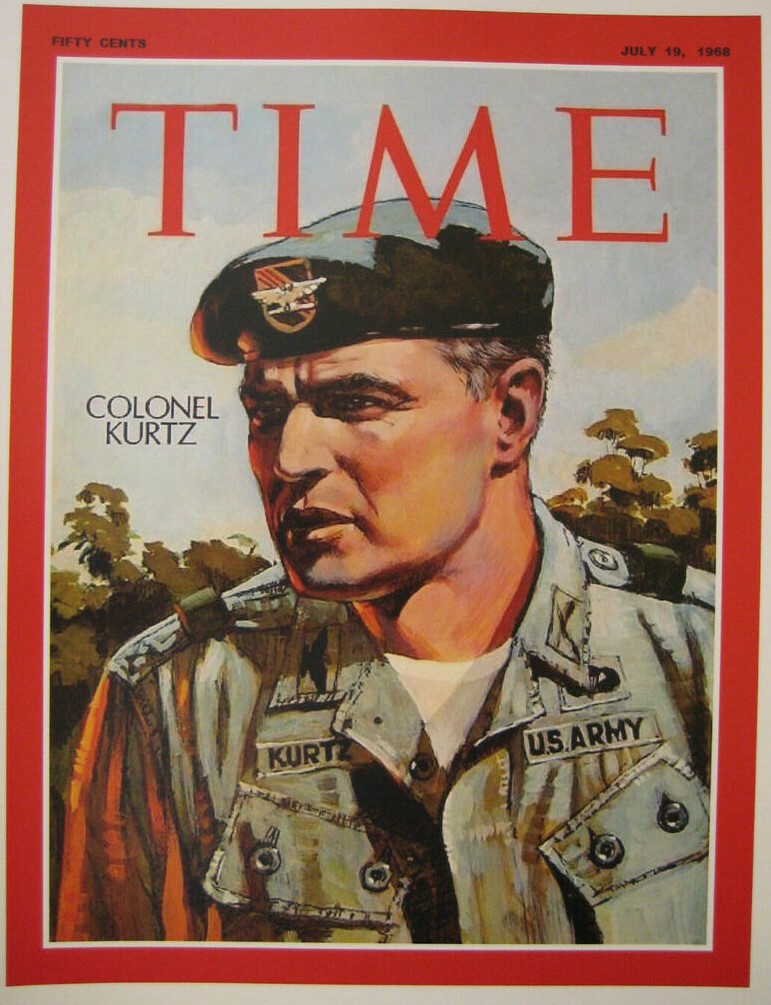
Horror and moral terror are your friends. Or so says Colonel Walter E. Kurtz, central antagonist of Apocalypse Now. Kurtz has gone AWOL, amassing a cult-like army of followers who indiscriminately rape and pillage under his command. He may have lost his marbles, but even Kurtz’s personal brand of savagery must operate on time and he needs a proper watch to keep the murder trains running. In this installment of How Villains Keep Time, we take a look at Marlon Brando’s psychotic military man and a most interesting Rolex GMT-Master.

About
I love me some Apocalypse Now. The entirety of Francis Ford Coppola’s Academy Award-winning masterpiece is one slow descent into madness; it highlights both the insanity of war as well as how damaging it is to the minds of those trapped within. That psychological gut punch is what separates this movie from the “war porn” category; action can be found aplenty, but you aren’t watching this film just to stuff your face with popcorn and watch the bodies pile up.
If you aren’t familiar with Apocalypse Now, it chronicles the journey of Benjamin Willard (portrayed by Martin Sheen), a U.S. Army captain who has been tasked with eliminating the sadistic Colonel Walter Kurtz (himself brought to life by Marlon Brando). Kurtz, who has gone rogue, is a special forces officer conducting an anti-Viet Cong guerrilla campaign along the Cambodian border. Initially green lit by his superiors to act with cart blanche impunity, Kurtz’s increasingly concerning penchant for public brutality as well as his summary execution of South Vietnamese allies he suspects of treason can no longer be ignored. In comes Captain Willard, our equally troubled problem solver, and thus the adventure begins.
Kurtz’s insanity goes beyond simple hedonism; he genuinely sees himself as a god. From a fortified temple deep in the jungle, Kurtz rules over a self-trained army of indigenous Montagnard fighters who wage his counter-insurgency campaign against the communists. It becomes clearer once we meet him, but Marlon Brando’s signature villain lives up to the reputation built up over the course of the movie. You never see the Colonel physically enact evil, but his words as a prophet of war carry a wicked weight. Kurtz eventually recounts to Willard a memory about vaccinating a village’s population of children against polio; upon discovery that the locals removed every single inoculated arm, his initial horror twists to recognize the potential of what he could achieve with a legion of these men so convicted to enact evil in the name of their beliefs.


I think one of the most important facets of Kurtz’s character is the emphasis from Willard’s superiors during their briefing that, at his core, Kurtz is a fundamentally good man. Lieutenant General Corman makes a point to Willard that he believes Kurtz’s moral compass became warped in the pressure cooker of his situation and he simply cracked – this quote succinctly summarizes Corman’s perspective:
“…Things get confused out there: power, ideals, the old morality, practical military necessity. But out there with these natives, it must be a temptation to be god, because there’s a conflict in every human heart, between the rational and the irrational, between good and evil, and good does not always triumph. Sometimes, the dark side overcomes what Lincoln called the better angels of our nature. Every man has got a breaking point. You and I have one. Walter Kurtz has reached his, and very obviously, he has gone insane.”
– Lieutenant General Corman, Apocalypse Now (1979)
Even our hopeful assassin recognizes the hopelessness of Kurtz’s situation. Despite the order to kill the Colonel, and even after the deed has been done (spoiler alert: Kurtz doesn’t ride off spiritedly into the Asiatic sunset) Willard shows both a measure of respect for the man Kurtz once was and empathy for the animal he had devolved into.
“Everybody wanted me to do it, him most of all. I felt like he was up there, waiting for me to take the pain away. He just wanted to go out like a soldier, standing up, not like some poor, wasted, rag-assed renegade. Even the jungle wanted him dead, and that’s who he really took his orders from anyway.”
– Captain Willard, Apocalypse Now (1979)
It is fitting in the context of what we know about Kurtz that his watch, a modified Rolex GMT-Master ref. 1675, invokes the qualities of both a mad man and a soldier. This was one of Brando’s personal watches that he chose to wear on set; after fighting with the filmmakers over its potential to distract viewers, Brando compromised by removing the bezel to reinforce both Kurtz’s status as a soldier and his ruggedness. He even hand-engraved the caseback for further personalization (emphasis on “hand” there, given the signature-like precision of Brando’s engraving).


There is no way of knowing if Brando intended it this way, but I think the removal of the bezel provides so much more commentary on Kurtz other than just impressing upon us that he is rough and tumble. The whole point of a GMT-Master is to track multiple time zones; without that 24-hour bezel, the GMT hand is useless. The missing bezel is an acknowledgement from Kurtz that he no longer belongs to civilization; he doesn’t care what time it is back in America because, like Willard said, Kurtz only takes his orders from the jungle now. The only reality that matters is his own, because mentally he has transcended into something beyond that of a normal soldier.

Philosophical waxing aside, Brando’s ref. 1675 is stunning. We’re talking an example of 1972 vintage, 3.24mm serial number, with a Mark IV dial and rounded crown-guards. The patina is perfect, with both the lume plots and hands having aged uniformly into a warm cream tone throughout, and the case appears to be in immaculate condition. Side-note, but it almost looks like Brando didn’t simply remove the GMT bezel but rather replaced it with one from a Datejust. I love this watch in its entirety; anyone who knows me is aware that the GMT-Master is my all-time favorite model, so to know it was featured on the silver screen prominently brings me joy.

If you are curious as to the fate of Brando’s GMT-Master, its provenance is fortunately well documented. Brando gifted his watch to his adopted daughter Petra in the mid-90s as a university graduation gift. Petra was its caretaker until 2003, when she gifted it to her husband Russel on their wedding night. Per Christie’s, Russel never wore the watch and it remained hidden from the public eye until recently when it went under the auction knife at Phillips in late 2019.
Brando’s watch performed solidly back then, selling for a stout $1.95 million including fees. In November of 2023, it went up for sale again at Christie’s and hammered for $5.1 million (also inclusive of fees), over double the previous auction price! $5.1 million certainly isn’t a record setter in the context of Paul Newman’s personal Daytona, which landed $17.8 million and is the most expensive watch ever sold at auction, but it is still a very healthy price tag nonetheless.
Double Feature
Marlon Brando’s GMT-Master ref. 1675 may be the primary focus of our discussion today, but we should quickly pay homage to a special guest star. Apocalypse Now produced not one, but two very special watches in the greater context of cinematic history. We spent a lot of time talking about Kurtz and his watch, but not the man who was tasked with killing him in Captain Benjamin Willard.

Willard doesn’t have the same level of moral bankruptcy as Kurtz does, but he very much battles (and sometimes loses to) his own demons over the course of the film as his situation deteriorates. We aren’t here to cross-examine Willard like we did Kurtz earlier, but we should note that Willard also has a special watch as part of his field kit to keep his own military operation on time; this is Seiko’s famous 6105-8110 dive watch.

The successor to Seiko’s first diver in the 62MAS, the 6105 isn’t quite as culturally ubiquitous as Rolex’s Submariner. However, I’d argue it is just as iconic and visually more unique due to its cushion case and 4 o’clock crown (which continue as Seiko staples even today). The 150 meter water-resistant 6105 remains distinct from a technical perspective in that it eschewed a traditional screwdown crown in favor of a more novel push-and-lock system. Overall, the 6105 epitomizes the same qualities of legibility and hardiness that Rolex’s signature diver stands for, and we have evidence aplenty of its usage by actual U.S. servicemen during the Vietnam War.

Unfortunately, the 6105 didn’t quite have the same staying power as that other watch – Seiko only produced the 6105 from 1968 to 1977. However, the 6105’s DNA lives on via descendants up to the current day; whether you want a zaratsu-polished limited edition in the SLA033 or the more budget friendly SPB153, there are 6105-styled options aplenty that benefit from modern construction. Even original 6105-8110s can still be had on the secondary market for $1,000 – $3,000, although fakes and cobbled together watches lurk everywhere; examine diligently and purchase with caution.
I am unabashedly biased given my ownership of a GMT-Master II; between these two watches, my heart naturally lies in orbit around Brando’s ref. 1675. Both the ref. 1675 and the 6105-8110 are horological juggernauts, however, and they are historically hyper important to their respective categories in GMTs and divers. Enthusiasts of any caliber will find it true that, with just these two watches (or even only one) representing the entirety of your collection, you would never need to reach for another watch.
—-
All GMT-Master Watch Images from Christie’s



Leave a Reply