
A brief list of wristwatch-related shower thoughts I want to show gratitude towards.
About
I hope you had a wonderful Turkey Day last week, gentle reader. It is a day to throw fitness-oriented caution to the wind, to revel in the hedonism of mashed potatoes immediately pursued by reckless amounts of online spending. I always regret the latter but am thankful for the former (which is my favorite Thanksgiving Day dish, in case you want to send me a treat). Shout out to Sarah, the architect responsible for making my butter and gravy-filled aspirations a reality. You are a wonderful cook.
Something else I am thankful for in this wintery season of reflection is, you guessed it, watches. I can write endlessly around my appreciation for watches in general, but I think there is equal if not more value to be found in specificity. There is no rhythm to what I chose to write about in this post, just the unorganized ramblings of a not-too-mad man barking about what he is grateful for in watches. Perhaps we’ll have more of these conversations in the future. For now, consider this my horological ode to joy.
You, The Watch-Curious And Watch-ObSessed
That’s right, give yourself a pat on the back. Don’t get used to it; I’m here to feed my own vanity, not yours.
I harp on watches being about the small details, but it is true that they are equally about the small moments. Watches gave me some of my closest friends and a treasure trove of memories: shout out to David Macdonald, Jesse Arrowood, Faisal Nayani, and the rest of the gang in Atlanta. These gentlemen are highly knowledgeable and I am grateful I can call upon their wit and intelligence with regularity.

Similarly, devoting my energy (at least semi-often) to the cause of counting sunny hours has afforded me the opportunity to more readily share the hobby with those developing a nascent watch-shaped interest. I love being the “watch guy” among my friends; nothing makes me more excited like a question on even the most introductory of topics. Buyer beware: querying me on watches will elicit more conversation than you initially had in mind. Brevity and I have long been adversaries.
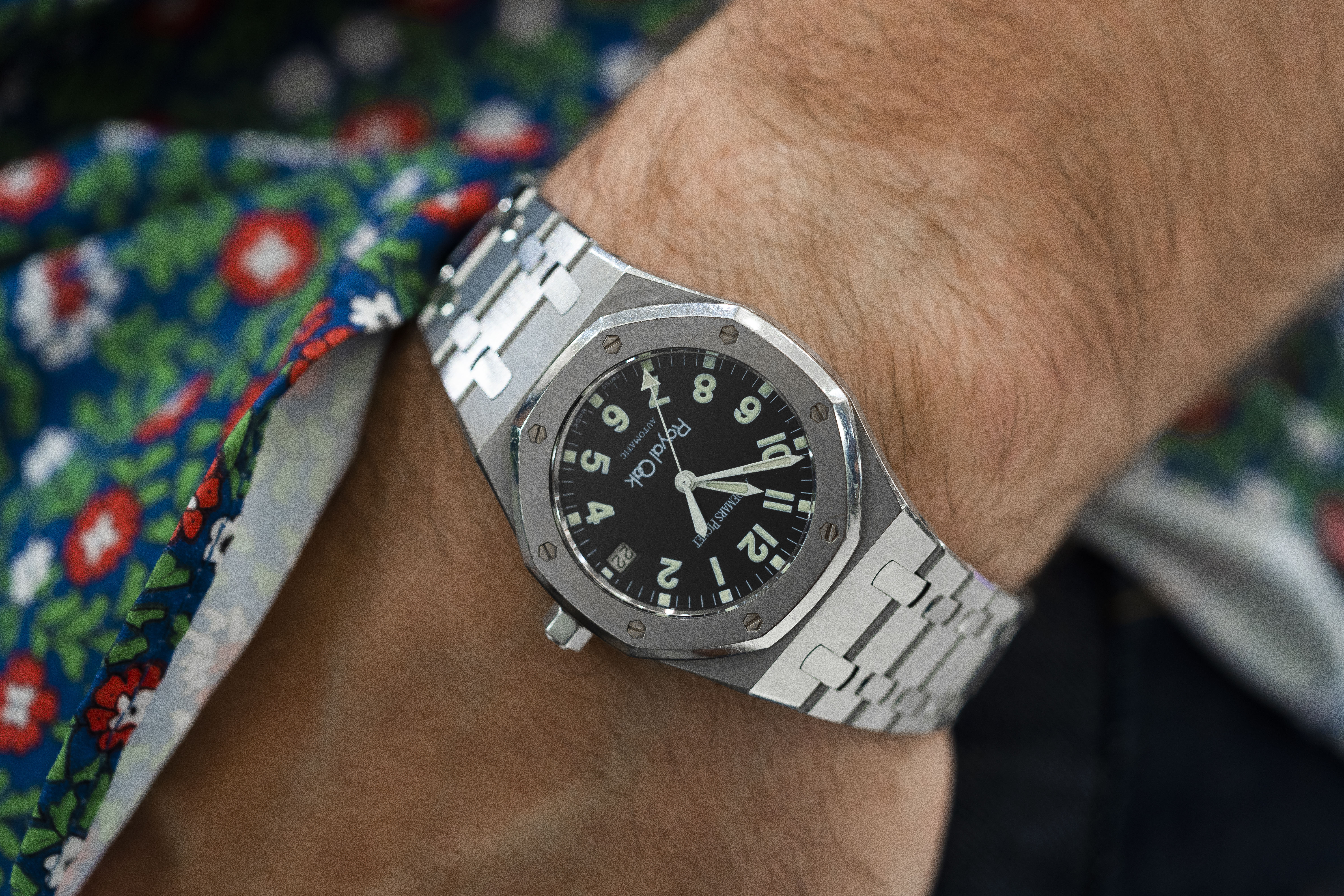
The Military Dial Royal Oak
The Royal Oak, Gerald Genta’s most favored son (at least by public consensus). Sure, the Polerouter gets the keys to the car for prom, and maybe the similarly polygonal Nautilus goes sailing with Papa Genta off the cape each weekend. But there is no disputing that it is the Royal Oak who has his ear.

If you were to look up the word “luxury” in a dictionary bereft of anything but pictures, I think there is a strong probability you would come across an image of the Royal Oak. Introduced in 1972, it technically wasn’t the first integrated bracelet sports watch (that honor belongs to the Zenith Defy from a few years earlier), but most would agree it has come to define the category.


Images by Analog:shift and Tropical Watch
Perhaps it is this ubiquity with extravagance and the one percent that has me loving a quirky early 2000s variation of the Royal Oak in the military dial variant of the ref. 14790 ST. Thick Arabic numerals with sword hands on a 36mm Royal Oak? A reference brought low to speak to the crudeness of the masses? Sacrilege. It’s most certainly the love child of a Hamilton Khaki knocking up a mainstream Royal Oak. There are worse bastard combinations between the nobility of watches though, and I think this one has plenty of legitimacy. In short: I adore the military dial Royal Oak for rejecting the fundamental nature of what we know a Royal Oak to be. I think you should, too.
Quick and dirty side-note on A.P.’s caliber 2225, the beating heart of the 14790 ST. It’s a 36-jewel workhorse with 40 hours of power reserve; that latter stat isn’t anything impressive by today’s standards, but you should know that the movement is derived from Jaeger-LeCoultre’s Cal. 889/2. This movement from the Watchmaker’s Watchmaker has guest starred for IWC and Vacheron Constantin as well. Weirdly enough, the 889/2 has 42 hours of power reserve. Perhaps A.P.’s CEO at the time felt that if you could sit the watch down for at least 40 hours, an emergency two hour grace period to come back from lunch was superfluous.
The 4:30 Date Window
Lightning bolt from the heavens incoming. It may not be your cup of tea, and it certainly isn’t mine, but diversity in watches is good and that applies to all facets of their design. This section isn’t so much dedicated to the 4:30 date window as it is to variety in our hobby.

I don’t own a 4:30 date window watch and I’m not targeting one anytime soon for a few reasons. Three o’clock is wide enough to properly fit double digit date numerals, while six o’clock is the best at unobtrusively preserving dial symmetry. 4:30 may not carve into any critical spots on a numerated watch, but it is often the weakest aesthetically when undergoing the eye test. Given many of us buy watches because we like the way they look, a 4:30 date window is just as liable to kill your interest in a particular piece as the case diameter being too big is.
Rant aside, the 4:30 date window being different is what makes it good (and it is beneficial to ever-cramped chronographs). An analogous if more material example is dive watches: if every brand offers Submariner homages, what incremental value do they bring to our hobby? Praise the divergent, the offensively non-conformist. Quick thumbs up to caseback power reserve indicators, oil-filled cases, Omega’s weird HEV nipple at ten o’clock, and everything else in watches that more often than not elicits a mean side-eye.

If you want an example of an imperfect solution being perfectly executed, look no further than Bell & Ross’s V3-94 Black Steel. It is the best example of the 4:30 date window bringing real value to an entire segment of watches. Unobtrusive and color-matched to boot – it’s almost revolutionary, at least as far as OEMs are concerned.
Non-Black and White Dial Options
Not all heroes wear black and white dials, you know. There is a whole world out there replete with watches that do not fit the conventional color palette profile. They’re really not that aggressive – their dials just aren’t what we consider “safe.”

Black and white dials have their place more often than not for a variety of reasons. They’re versatile, oft working well for occasions all along the formality spectrum, and give you the largest range of flexibility when it comes to non-bracelet straps. That being said, they are everywhere. Why not live a little?


I love vibrant dials simply for the obvious pop they bring to your uniform. Monochrome has a color quotient of its own, don’t get me wrong. A well-rounded watch collection carries multiple flags, though, and I encourage you to diversify if it is within your financial ability to do so. Doxa, anOrdain, Seiko, Bulova and many other brands carry colorful options to make this (my) dream for you a reality.
Tudor And The Black Bay Lineup
Tudor’s revival in our ‘hood has been nothing short of dominant. The brand returned to North American consumers in 2011-2012, bearing gifts in the form of the original Black Bay and Pelagos. Those watches have given real life to a brand that left us in 2004 and has wrongfully long been considered a side show to Rolex. Even if the design language is thoroughly parental, Tudor carries itself with the gravitas of a solo act.
I can’t count the number of times I have had the “first serious watch” conversation this year (a conversation I live for, by the way). More often than not, that conversation begins and ends in some capacity with Tudor and the Black Bay. I recognize the anecdotal subjectivity of my experience, but the numbers speak to the public’s heightened interest in the brand: from 2019-2023, Tudor’s sales grew at a CAGR (compound annual growth rate) of 23%. Note: Tudor doesn’t release sales data on individual models, so we have no idea how many Black Bays (reference agnostic) have been sold since inception. Regardless, it is very safe to assume this watch is at the forefront of their successful efforts to position themselves as the attainable heirloom brand of the early 21st century.


The original 79220R “Smiley” and its progeny, the Black Bay 58.
I don’t think it should be a surprise why the Black Bay is so successful. We are in a prolonged industry phase of “vintage-inspired,” and the Black Bay’s various iterations are callback rich. Gilt styling, the Tudor rose, the red triangle pip at 12 o’clock, etc.; the list goes on in perpetuity. You want a Submariner like the one Sean Connery wore? Congratulations, you can buy a handsome BB58 (the current standard bearer) for a fraction of the cost it would take to acquire a big crown ref. 6538, and you can even wear it outside the house without fear of losing your shirt.
Is there some danger to being known as the Black Bay company long-term? Probably. But every brand has its signature model, and from the O.G. 79220R “Smiley” an entire wellspring of Black Bays has erupted. The public is voting with their dollars, and as long as they keep voting for Tudor, Tudor will keep providing us with the goods. Black Bay or not, it is a positive for the world of watches and a brand that was once dormant in North America. Interest in Tudor equals interest in watches, and that is healthy for our hobby.

Related: if you find yourself struggling to fall asleep tonight, my review of the Black Bay’s cousin in the Pelagos 39 is sure to drift you right off into the heart of your REM cycle. Call it light reading for a heavy sleep.


Leave a Reply