
Happy birthday to my darling girlfriend, Sarah, for whom writing is simultaneously the freest and most cherished gift I can provide.
About
Conventional wisdom tells us that a well-rounded watch collection is heterogeneous. It is an adage that exists in harmony with the idea that, for most of us, tastes evolve. A new watch enthusiast might start with divers, then transition into dress watches or high complications as their collection grows (and their wallet shrinks). Not all of the existing watches get sold with each transformation, however, and over time, said enthusiast’s collection becomes both an archive of previous interests as well as a well-diversified assortment of watches.
I think we can all agree at some level that this is a good process to undergo, semi-passive and subtle as it is. It is beneficial to have a multifarious collection, because we can learn to appreciate other styles not necessarily in our traditional fairway. I advocate diversity for new watch lovers – and even those old curmudgeons set in their ways – because it encourages a more holistic view of our hobby and better dialogue with other enthusiasts.

Well, at least that’s what I like to say out in public as a self-appointed steward of the hobby whose moral obligation is horizon-broadening. Here, when it is just you and me talking privately, I have an alternative philosophy to ply.
Here’s a groundbreaking thought, free of charge – what if you simply don’t form a diverse collection? Who is to say you can’t be happy collecting things that conform to one zip code? As a pertinent personal example, I love GMTs and never grow tired of trying new ones; travel watches emotionally overtook chronographs for me a long time ago, and that hasn’t shifted in years. Long live the coup de foudre that strikes thrice – sometimes you are captivated by a type of watch for the last time, and that’s okay.
We have a new column here at CSH: Uncommon Common Denominators. It’s dedicated to the art of orienting a watch list around, well, an uncommon common denominator. Think topics like watches with Oreo bezels, or watches with a minimum of seven words in the model name. We are beyond investigating divers below $500 and are moving into a territory that is significantly more niche.
My self-imposed guidelines are as follows:
- The collection should be a total of five watches – my personal favorite, and the best of the rest.
- The collection shall be budget-agnostic and assume availability, even if no longer in regular production or limited in scope.
- The collection should be as diversified as is reasonably possible across brand, era, and archetype.
The die is cast. Our underlying theme for today? Fun, unadulterated and unrestrained.
What do I mean by fun? Well, I’m talking playful. Irreverent. Downright disrespectful to Swiss conservatism in all the most despicably lighthearted ways. The best way I can put it isn’t even the best way I can put it, as I’m going to quote Rick Atkinson’s The British are Coming (which has no legitimate connection to watches whatsoever, but is a novel that I have been reading vigorously) in a horological context – we want watches that are “authentic and unpretentious in an inauthentic, pretentious age.” To me, the appropriate label here is curios – unique novelties whose underlying value is anything but cheap. Let’s get started.
Aw, Phooey: The Gérald Genta Retro Fantasy G.3632 “Donald Duck Golfing” Dial

Okay, it might be a spicy take not to select Mickey Mouse here. It might even be spicier not to have selected the original Swatch collection. However, this is a subjective list, and I prefer Donald Duck over Mickey for the relatable avian goofball that he is. Don’t worry about Swatch, either: we’ll briefly touch on Switzerland’s king of color in a bit to make sure credit is given where due.
Gérald Genta’s career is a storied one, even when you reduce it down to the spark notes. He is the sculptor behind the Polerouter from Universal Genève and some of the watch world’s greatest integrated bracelet sport models – think the Ingenieur from IWC, Audemars Piguet’s Royal Oak, and Patek Philippe’s Nautilus. Recognizing there is always Genta hype in the air, I think it is a fair claim that there is probably isn’t another watchmaker in the modern era who has had a more prolific design footprint than Genta.

In 1969, Genta started the first of his two watch companies, aptly named Gérald Genta (the second, Gérald Charles, used his middle name and wasn’t founded until 2000). During the 80s, he secured an exclusive licensing agreement (originally spawned from a Disney executive’s fan request) to emblazon the image of famous Disney characters – Mickey, Donald, Minnie, Goofy, and others – on his watch dials. The first watches came out in 1984, and as you might expect, were delivered with mixed results. This story by Ariel Adams at aBlogtoWatch sums up well the accusations of heresy; apparently, the powers that be at the time snarkily asked Genta not to display his apostate products at Baselworld.
In the 90s, Genta introduced the retrograde complication across his lineup. The easiest way to think about it is a 180-degree half-moon arc that snaps back to the beginning after a set period of time (both minutes and hours are possible use cases). In the case of Genta’s Disney lineup (which he called the “Retro Fantasy” collection), he crafted a unique way to tell time by combining a retrograde minutes complication with a jumping hour complication. For the movement nerds among you, a familiar suspect is lurking under the hood – Genta’s complications are modular and sit atop the shoulders of the ETA-2892, a classic off-the-shelf luxury movement.


Image Credit: Amsterdam Vintage Watches
As I alluded to earlier, the Retro Fantasy watches came in a variety of different Disney flavors. This 35mm Donald Duck example makes my heart sing – the stippled, almost linen-like texture of the dial really makes Donald feel like he was plucked off the cartoon artist’s easel – and the retrograde scale features Mother-of-Pearl for perfectly glossy contrast. And don’t even get me started on that superb font choice for both the retrograde minutes and jumping hour aperture.

The original Disney watches unfortunately didn’t last into the 2000s. While they survived one acquisition by Singapore-based retailer The Hour Glass in 1996, they were discontinued in the wake of Bulgari’s takeover in 2000. Limited runs of Mickey were brought back in 2021 and 2022, but both versions (the latter of which had Mickey playing soccer) are definitively scarce in their plurality (150 and 200 units, respectively).
For now, the serialized production of Genta’s Disney collection appears to be a thing of the past. I appreciate the Retro Fantasy watches for what they are at their core: rebellious, complicated timepieces that offend the orthodox notions of haute horlogerie. Who says Mickey and Donald can’t be fancy?
This particular example was curated by Amsterdam Vintage Watches. It is no longer available, but you can visit the original listing here and check out the rest of their current offerings.
Objectively Subject: The List
Let Them Eat Numbers: Mr. Jones ‘Number Cruncher’

“We make statement watches that tell a story, start a conversation or simply make you smile. We are proud to be different.”
The quote above is the opening stanza from the “About” section of Mr. Jones Watches. “We are proud to be different” – now there’s a line in the watch world that you can get behind. This London, U.K.-based watch company was originally founded in 2007 by Crispin Jones as a solo operation at home. 18 years later, Mr. Jones Watches has a full lineup, a lovely retail location at Covent Garden, and a mission ethos focused on sustainability – all packaging used for MJW products is 100% recyclable, and all watches are guaranteed for lifetime repairs to boot.


The Monster Melter 3000 and A Perfectly Useless Afternoon. Image Credit: MJW
To simply call MJW’s watch designs unusual would be a disservice to the company and the artist-designers it collaborates with. Just about every watch has a wildly playful design and a creative way of directionally telling time. Do you like ancient aliens? Perhaps the Monster Melter 3000 is suitably extraterrestrial. Lamenting the loss of summer and lazy days by the pool this fall? A Perfectly Useless Afternoon might be the dopamine boost you are looking for. Between these two watches, you can use either a severed tentacle or a stretched leg to count the hours. A spaceman’s ray gun and a rubber ducky play second fiddle for the minutes.
These are just two examples from the graphically wild watch collection that MJW has to offer. The best part? Except for one special model, they are all supremely affordable. The basic quartz options run in the $200-$300 range, with a few of these models being offered with mechanical movements in the $700-$800 range. You could go buy a Sellita-powered Submariner homage to fill out your already extensive dive watch collection… or you could take the lowest dollar-investment chance of your life and pick up an MJW. I think you know which way I am pushing you.


Image Credit: MJW
It is apparently Jump Hour day over here at CSH. My pick from Mr. Jones is the Number Cruncher, which is a historically accurate depiction by Onorio D’Epiro of Godzilla’s cousin raiding Switzerland for clocks at the outset of the Quartz Crisis. The Number Cruncher’s technical specifications are quite charming and well-mannered for the dollars requested. You get a Seagull TY2709 automatic jump hour movement, 316L stainless steel construction, a sapphire porthole, and 50 meters of water resistance all for just $295.


Image Credits: MJW
Being frank, I’m fairly simple-minded here: I just really enjoy this funky rendition of a big blue dinosaur (which almost feels like it stylistically belongs on Cartoon Network). The jump hour “cookie” about to be snacked upon, as well as the minute track being digested in his stomach, is about as clever an arrangement as I’ve seen from a watch at this price point.
The Number Cruncher and its eccentric siblings convey a child’s wisdom about the necessity (or lack thereof) of watches, one that traditionalist Geneva would scold you for even considering – watches stopped being essential pieces of kit decades ago, so why not have fun when designing them? Live a little.
Like A Stone: The Tissot Rock Watch

Do you like rocks? Are you a fan of naturally occurring geological formations aggregated via mineral matter? Or perhaps you appreciate the muted coloration of Terra Firma? Well, buckle up and settle in – I have just the proposition for you.

In the early 80s, the Swiss watch industry was still trying to break free from the grips of the Quartz Crisis. The first plastic Swatch (from the eponymous group that owns Tissot) dropped in 1983 and is credited with saving the Swiss watch industry. It was a radical disruptor defined by three traits: affordability, plastic materials, and the saturation of color. The Swatch is the original standard-bearer for personality in the watch world; in many ways, it saved the Swiss watch industry by opening up Swiss watches to newer generations at the bottom end of the market (a segment that Seiko had been dominating thus far).

In 1985, Tissot launched a product that, while philosophically aligned with the Swatch, was its material antithesis: the RockWatch. Hewn from granite sourced locally from the Jungfrau in the Bernese Alps, the RockWatch feels like a Cartier Pasha that had a run-in with Medusa. Solid granite might signal the expectation of something material in size, but the original RockWatch was anything but – you could choose from one of three petite case sizes in 23mm, 30mm, and 33mm. Similar to the Swatch, the RockWatch was powered by a cheap off-the-shelf quartz movement from ETA.
At a price of just $200 USD, the RockWatch was an immediate hit for Tissot as their means of re-entry into North America: in 1986 alone, the company sold over 50,000 RockWatches. Total units sold are estimated to have reached north of 800,000 by 1994. Tissot followed up with material variations in the short term to capitalize on its success, launching the PearlWatch in 1988 and the WoodWatch in 1999.

A quick perusal of eBay will turn up as many examples as you deign to examine. If vintage isn’t your thing, however, you should know that as of September 2025, the RockWatch is officially part of Tissot’s catalogue again. Tissot announced a limited run of 999 pieces, all of which will be sold exclusively at Tissot’s 5th Avenue boutique. The new model is predictably similar to the original, with two key exceptions: 1) the hands are albino instead of the original ketchup and mustard combination, and 2) the case diameter has been brought into the modern era at 38mm. It also costs substantially more, as this limited edition will set you back a whopping $1,225 USD. My advice? Save yourself the money and buy a vintage example online if your wrist is slender enough to handle 33mm.
Keeping in mind that I have never handled a RockWatch in person, it does make me ponder the psychological effect of watch weight in the most reductive of manners. Watch buyers often care about their watches having a certain weight to them, which is why materials like titanium or ceramic are not universally loved. Is it enough to simply be heavy to be perceived as having value? Most assuredly not: otherwise, every time someone achieved something of great import, they would go hunt down a RockWatch instead of a Rolex. Maybe we’ve simply missed the mark on what a proper celebratory purchase is. Henceforth, my future advice shall be the following whether you are earning an advanced degree or turning 40: Go Natural. Go Granite.
Forget Salmon: The Isotope ‘Wasabi’

Isotope is the second English brand on our list; José Miranda and his wife Joana founded the brand in 2016 out of Henfield, which is situated approximately two hours south of London towards the English Channel. Their approach to watches is focused on personal expression and involves a fusion of pop culture with multiple design languages. Art Moderne, Art Deco, and Brutalism are all core inspirations for Isotope’s creations.
I had the pleasure of meeting José at both a brewery meetup and a few of the summer events we covered earlier in the year. He’s a lovely fellow with a great sense of humor who is passionate about his creations. José, thank you for educating Sarah about the Quartz Crisis. I am now educated about said Quartz Crisis at least once per day. There is a monster loose in our house, and it isn’t the Number Cruncher.


The very first thing José taught me about Isotope was the thesis behind the brand, specifically in the context of the Hydrium Ooh La La and its gorgeous golden hour dégradé dial. He said there were no watches on the market that he wanted to wear, and so he executed on the simple calculus that he would set out to make the exact watch he desired. I like the earnestness of it all – we’ve all had conversations about what we want in our ideal watch, but very few of us go out and chisel the idea from metal.
The intersection of Brutalism and pop culture is probably most obvious in Isotope’s burly Hydrium dive watch line. While the dial options can be whimsical (and limited, usually in increments of 20), their playfulness should not be mistaken for a lack of robustness. The Hydrium is water resistant to 300 meters (far more than you’ll ever need, you desk jockey) and comes equipped with both a unidirectional 120-click relief bezel and a knurled screw-down crown. The automatic La Joux-Perret G101 Soigné grade within hums at 28,800 vph and has a stout 68-hour power reserve. Isotope regulates these movements in four positions to +/- 7 seconds per day.


The Hydrium Coconut Island and Exit. The Exit is sold out, but you can still grab the former if you move quickly. Image Credit: Isotope Watches
The Hydrium case is the brutalist half of the equation. Built from micro-blasted 316L stainless steel, it weighs in at 40mm x 48mm lug-to-lug and 12.9mm tall with a 22mm lug width. On the other hand, the sapphire-protected dials can often be a vibrant juxtaposition to the case. The Ooh La La is my personal favorite by simple virtue of color saturation. Another lively example is the Coconut Island, whose silver sunburst dial features coconut trees for hands with a coconut atop the center pinion that functions as the central seconds hand. Certainly, there is a trade-off to a second hand that doesn’t reach the theoretical perimeter of the minute track… but it’s also a coconut. It’s an important reminder that the spirit of the exercise here is more so form, not function.


Image Credits: Isotope Watches
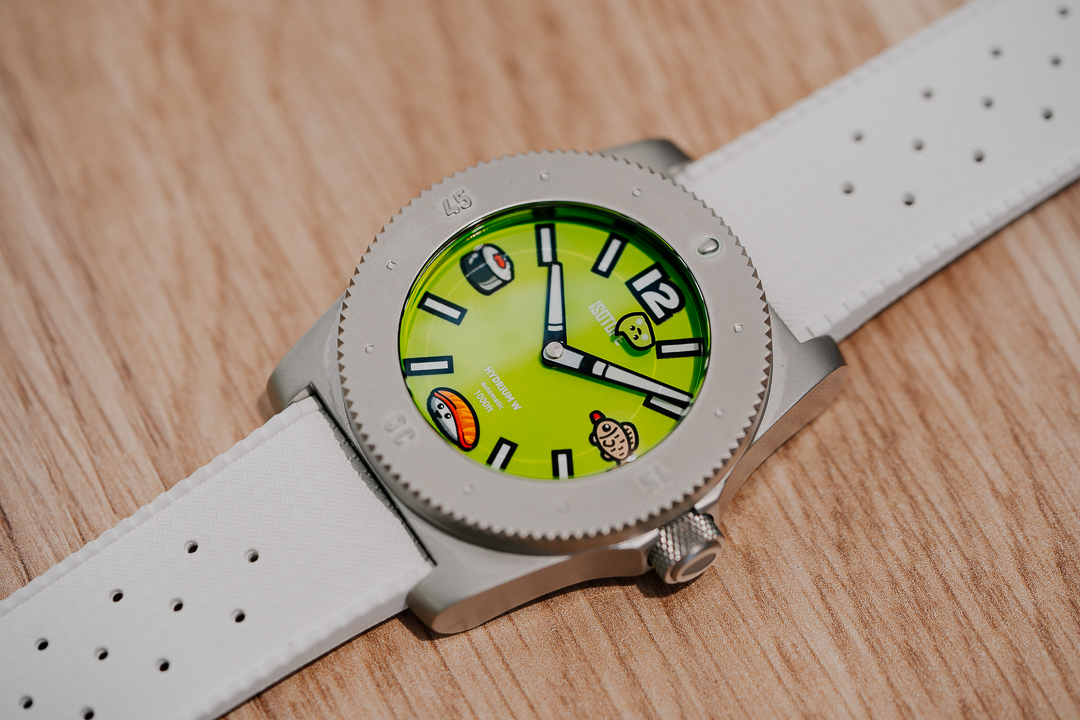
While I have a major internal bias towards the Ooh La La, I’m going Japanese with this round’s pick in the sushi-inspired Wasabi. It’s hard to bury the lede on this one – the dial is a vibrantly bold (and fully lumed) Wasabi green. Isotope’s trademark lacrima hands are swapped out for laser-cut and painted chopsticks, while the second hand is a floating dollop of wasabi. The indices are just as fun as that wasabi dab – 3-6-9 show lovely cartoon graphics of a Shoyu-tai, Nigiri, and Sushi.


Even though the Wasabi doesn’t have lacrima hands, it still features a lacrima motif on the rotor similar to other Isotope models.
Keeping in mind that there is a poetic angle to a watch from a brand called Isotope that glows almost radioactively after hours, I’m not sure there’s much more to the Wasabi other than the idea that being silly with watches can be far more fun than going traditional. The Wasabi’s description on the Isotope site likely says it best. “The Wasabi is a reminder that watches can (and should) be fun. And in a world of safe dials and serious faces, it’s the fresh kick we all needed.”
Instant Time, Just Add Coffee: Brew Watches – Metric ‘Digital Blend’

Time to take stock – we have run through Donald Duck, dinosaurs, rocks, and wasabi. I expect that the audience at the intersection of these topics is quite small; not that you aren’t out there (I’m sure there are dozens of you), but I am not entirely convinced that you are perusing this website. Perhaps our next topic, coffee, will widen the Venn diagram.
Ah, coffee, bearer of caffeine, that great enabling boon of employed peoples everywhere. Your worshipers are legion, endlessly praising your ability to keep them alert (with diminishing returns and ever-decaying marginal utility) throughout the day. In the same way that coffee helps keep many of us on time with our tasks, perhaps it makes sense that there is a watch specifically to help time the creation of said coffee. Enter Brew Watches, which was founded in 2015 in New York by industrial designer Jonathan Ferrer. What started as a Kickstarter crowdfunding project has grown to encompass four model lines, all inspired by industrial espresso machines.

Image: Brew Watches
Like Tissot, Brew also chose September 2025 to drop a new hit with their latest model in the Metric – Digital Blend. The Digital Blend is a super funky analog-digital (“ana-digi”) watch that comes equipped with a 30-second LED espresso timer (dare I say complication) in the bottom steel-framed section of the dial. For the uninitiated who don’t care for coffee, 25 to 30 seconds is commonly accepted as the theoretically perfect range of time for an espresso shot pull with a 1:2 coffee-to-water ratio.


Image Credit: Brew Watches
The Digital Blend still has the key Brew retro-aesthetic ingredients, a stainless steel cushion case with a flat-link bracelet, and is conservatively sized at 37.5mm by 43mm lug-to-lug (which is in the general zip code of Brew’s typical sizing). The ana-digi movement makes the Digital Blend beefier than its siblings, however, as this model taps in at 13mm – most Brew watches sit squarely in the 10.75mm context. If you already have experience with Brew, the additional ~2mm of thickness here might feel onerous. Either way, the measurements remain perfectly wearable independent of user experience with the brand. The Digital Blend is priced affordably like Brew’s other watches at $425 USD.


I love that the Digital Blend’s reason for existing is just to time 30-second espresso pulls. There’s no adjustability in the timer; you can’t reprogram it to 15 seconds, 10 minutes, or an hour. You get one setting and that’s it, full stop. It reminds me of an age where there were watches made specifically for single-use cases, like the Bulova Parking Meter chronograph (used to avoid those pesky parking tickets) or the Vulcain Cricket (which doubles as an alarm clock and was gifted to presidents). Both of those watches exist today in reissued form, but the Digital Blend is a unique first. In a world where Switzerland will beat you to death with the same watch over and over again, that’s a good quality to have.
—
I’d be loath to call the watch world devoid of fun. Certainly, the watches on this list fit into the extreme, most purified form of the word – they’re apt to hit you in the face with the dictionary definition and are probably the watches least in need of explaining why they fit the mold. Along a related vein, I fully recognize the subjectivity of this list and that, if I wrote it ten more times, there might be fifty new watches. But perhaps that is the beauty of it – fun comes in all shapes and sizes. And despite my propensity to attack the genre with gusto, a Sellita-powered Sub homage is fun at times.
We’ll revisit this column next month with a new uncommon common denominator. Cheers.


Leave a Reply