
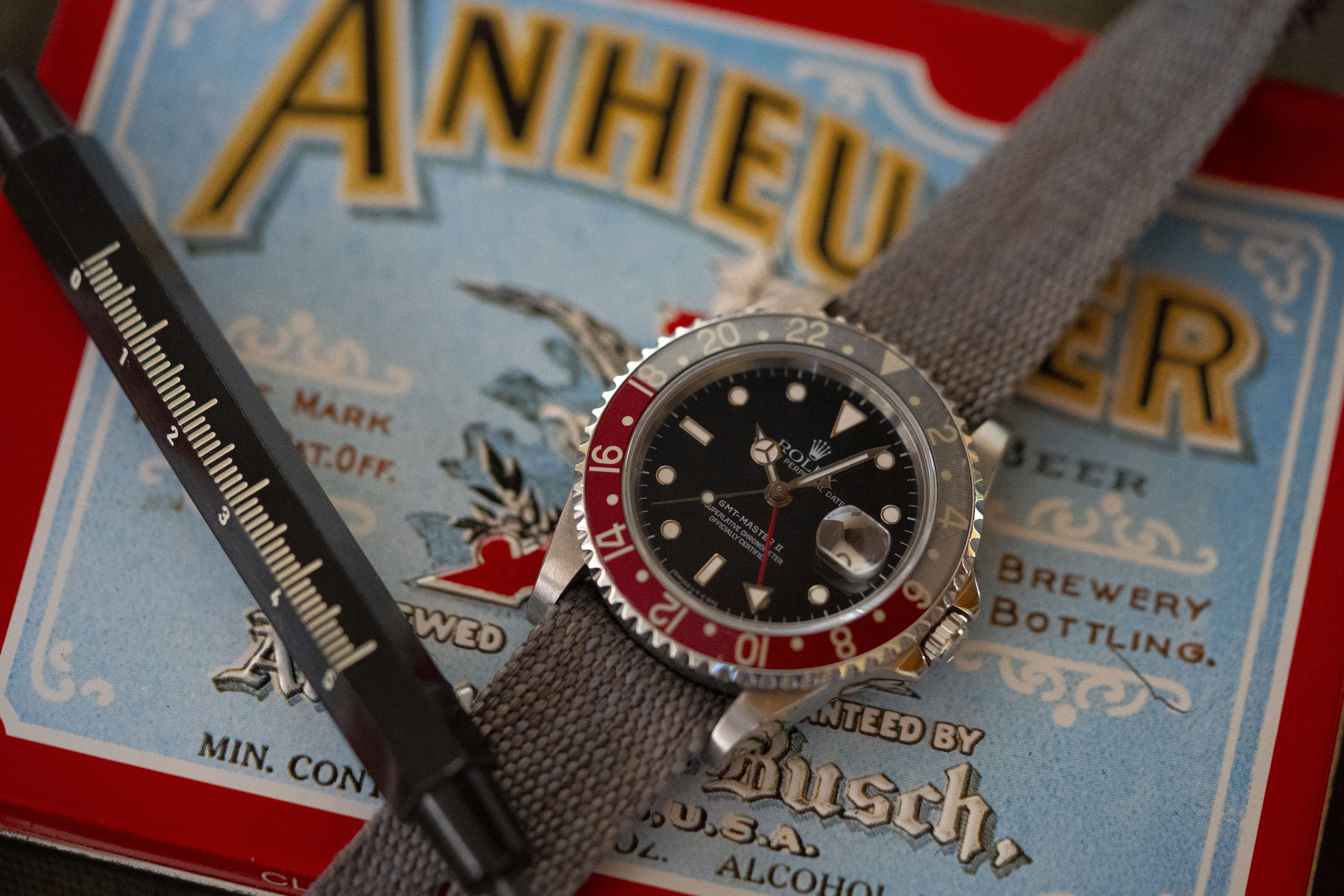
Call it love at first sight, but the Rolex GMT-Master has me smitten. The history of this handsome watch and its typically bi-colored bezel is all romance – originally created in 1954 for Pan Am pilots ferrying jet-setters to distant destinations, the GMT-Master prides itself on having the same panache that other Rolex models pride themselves on avoiding. Today we are looking at the GMT-Master II ref. 16710, an early reference of the successor series, and the last of the pre-Maxi case watches with an aluminum bezel insert.
About
Okay, we’ve known each other long enough that I can be honest – I am unabashedly a giggly GMT-Master fanboy. Unique, right? Bet you have never heard someone say they like Rolex before. Not that the Crown really needs adulation from a small-time watch blogger, but I have to give compliments where due because this watch has had me bewitched since day one. In my introduction post, I put forward the idea that watches largely go out into the world soulless, become associated with memories over time, and eventually evolve into something more organic (think “Dad’s Seiko”). I do believe an exception can be made for a few specimens that live larger than most. The GMT-Master can count itself amongst their number.

Getting to the ref. 16710’s chapter in the story requires a little illumination about the original watch’s purpose. In 1954, Rolex responded to Pan Am Airways’ S.O.S. for a watch its pilots could use to read multiple time-zones. Enter the GMT-Master ref. 6542, which was equipped with an additional ‘GMT’ hand and a rotating 24-hour bezel fashioned from Bakelite (i.e. the O.G. plastic). This setup effectively enabled users to set the new hand to a specific time zone; afterwards, the bezel could be rotated to coordinate a second time zone. It may not have been made for James Bond, but a watch specifically issued to Golden Age pilots still warrants an A+ as far as origin stories go.

If you are wondering what the heck being a “master of GMT” entails, GMT stands for Greenwich Mean Time and is the mean solar time from the Royal Observatory in Greenwich, London. GMT was used by intrepid mariners to calculate their longitude from the Greenwich or Prime Meridian (considered to have a longitude of zero degrees) and was labeled as such until 1972, when it was re-named to “Coordinated Universal Time” or UTC. Technically speaking, nowadays the former is a time zone while the latter is a time standard. However, confused watch lovers need not lose sleep at night – they are effectively identical for purposes of telling time.

The original ref. 6542 is where it all began, but the fact that Bakelite is notoriously fragile ultimately doomed it to a short production run. In 1959 the ref. 1675 was introduced, equipped with crown guards and a standard aluminum bezel insert; this watch represents the core design language of the GMT-Master and GMT-Master II until 2007, when key updates were introduced (more on this later).
Weirdly, both lines were in concurrent production across two decades; the upgraded Master II came out in 1983, but the original GMT-Master (in the form of the ref. 16700) remained in production until 1999. There are several key differences between the two series, but what you should know is that GMT-Masters utilize “caller” movements with an independent GMT hand. Meanwhile, the Master IIs have “true” GMT movements with a jumping local hour hand.

Our co-host for today was the second GMT-Master II reference to be produced and was manufactured with iterative changes from 1989 to 2007. The ref. 16710 was powered with the local jumping hour-capable Caliber 3185 until 2005, at which point the movement was replaced with the upgraded Caliber 3186 which uses a Parachrom-Bleu hairspring. Fate has dictated it is almost impossible to identify the movement via external examination, but if your GMT hand tends to squirm when changing local time, a 3185 is likely ticking away inside.

Visually, this reference was the last to be fitted with an aluminum bezel and came in one of three flavors: Pepsi (blue / red), Coke (black / red) and Noir (all black). Bezel optionality is the cat’s meow of the ref. 16710 – if you want to spice up the watch’s appearance, a taped butter knife and some torque will do the trick. Aluminum bezels tend to naturally fade over time via UV light penetrating the clear coat. In my mind, the bezel taking on a life of its own is what makes these watches so appealing. We have a legion of examples where GMT bezels have become faded into brilliant hues or gone full ghost grey as you can see with my own example; the bezel gives these watches a layer of flamboyance not found elsewhere with Rolex.

The luminous material on the ref. 16710 also existed as a trio of different options, but their usage is separated by time ranges. From 1989 to 1998, tritium was used on both the indices and hands – the quickest tell is yellow patination of these elements and the dial being marked “SWISS – T<25.” In 1999, luminova was tagged in and the dial nomenclature switched to “SWISS” only. From 2000 to the end, super luminova was used and the dial was again relabeled to “SWISS MADE.” The creamy warmth of aged tritium is the most inviting to me personally, but if you absolutely need nighttime functionality, anything post-1998 will be a solid operator.

This doesn’t have a tremendous visual impact, but the dial of the ref. 16710 comes in multiple versions; the “II” in the line of text below the central hands pivot can show up as either Roman numerals or less common fat font “sticks.” These stick dials also tend to have an extra space after the dash before “Master.” This variant is much rarer, and despite commanding a premium, is also dubiously more valuable; I have seen claims that these dials were made erroneously, but the more likely explanation is that this variant is simply a different manufacturing run.
Flying With Style
So, what makes the GMT-Master so cool? Plenty of watches use colored bezels, and Rolex doesn’t own a monopoly on paint schemes. The oyster case is used universally across Rolex’s lineup, so there isn’t a unique metal footprint either. From a technical perspective when comparing against other brands, I do think Rolex’s design is the cleanest amongst GMT-equipped competitors, and the ref. 16710 represents the ultimate refinement of the GMT-Master II as it existed when the tool aesthetic still took priority for Rolex. There is a certain charm to the ref. 16710’s profile, and we know those bezels age like fine wine given enough mileage.

If you continue considering the tool aesthetic component of the story, the ref. 16710’s vintage proportions are more approachable than its successors. As a reminder, this is the last GMT-Master II that featured an aluminum bezel insert, tritium indices, stamped bracelet end-links and drilled lug holes (at least through the mid-90s on those last three items). In 2007, the ref. 116710 was introduced, featuring a ceramic bezel, thicker ‘maxi-case’ profile, and polished center-links on the oyster bracelet. The end result is a watch more suited for the modern consumer, but with a much blingier appearance. Let me be clear – the modern renditions are wonderful watches. Old souls just get stuck on old things, I suppose.

In the days of yesteryear, Rolex watches were intended for rugged everyday use. While today’s Rolexes are more robust and capable than the older models ever were, the rise of social media has transformed them into status symbols and pseudo-investments – online forums are littered with concerned posts about small scratches or hopping in the pool. As someone who wears his watches in all scenarios, I can’t help but lament how modern Rolex has been co-opted by fake watch enthusiasts as a tool for flexing. If you extrapolate the original intent of the watch as a tool made to equip pilots on long-haul journeys, it should be used as a worry-free companion that can take the bumps and bruises life delivers along the way.

Indeed, the provenance of the Rolex GMT-Master and Master II is what really makes it so special. I love the visualization of being up 36,000 feet aboard a Pan Am aircraft not yet optimized to pack passengers in like sardines. I can see tired eyes keeping track of multiple cockpit instruments as businessmen slumber restlessly to the rear, unregulated dreams flowing through their heads. The captain of this particular flight glances to the blue and red splash of color on his wrist, eyeing the local time in New York at roughly 7:00AM ET – perfect timing for the plane to touch down and experience Helios dancing across the cityscape. Fictional or not, this sounds like a heck of a scene to me.

The GMT-Master II ref. 16710 may not have been the exact model on our Golden Age pilot’s wrist, but it does carry the same level of wonder and potential as the ref. 6542 that came decades before it. This version is modern enough that you can fearlessly beat it up while still benefiting from vintage style cues – what more can you ask for than a true GMT movement and 100 meters of water resistance, all packaged within 12mm of thickness? Modern brands like Tudor are unable or unwilling to crack the code – price delta aside, we only need look to the relatively recent past, not the present, for the trifecta of functionality, wearability and stylishness.
The Specs:
- Case Material: Stainless Steel
- Crystal: Sapphire
- Features: True GMT with Local Jumping Hour Hand
- Movement: Rolex Caliber 3185 or 3186 (Automatic)
- Power Reserve: 50 Hours
- Screwdown Crown: Yes
- Bezel Movement: Bi-directional
- Caseback: Screwed in, non-display
- Water Resistance: 100 Meters
- Case Diameter: 40mm
- Lug-to-Lug: 47mm
- Lug Width: 20mm
- Thickness: 12.5mm


Leave a Reply