
Now I have a Cartier. Ho-ho-ho.
About
Let’s address the elephant in the room: Die Hard is a Christmas movie. There, I said it. You can’t convince me otherwise. The movie takes place on Christmas Eve with Christmas songs in the soundtrack. The hero’s wife name is Holly. The release date was July 1988 – literal Christmas in July for action flick addicts everywhere. I shall hear no more debate on the topic.
Based on Richard Thorpe’s 1979 novel Nothing Lasts Forever, Die Hard raced past soft expectations and became both the highest grossing action movie of the year as well as seventh highest grossing overall, with global box office dollars totaling $140 million. Movie critics often point to this film as the catalyst that elevated Bruce Willis to leading man status and turned Alan Rickman into a movie star (this was Rickman’s first feature film). Evidence supports their collective position, as Die Hard clocked four Academy Award nominations the following year. Not too shabby for a movie that actually omitted Willis’s image from select promotional materials.

Die Hard’s plot is a down-the-fairway action classic. NYPD Detective John McClane (Willis) is estranged from his wife Holly, who works for Nakatomi Corporation in Los Angeles. An accidental invitation to her holiday party causes a game of cat and mouse to erupt as Hans Gruber (Rickman) and his merry band of West German burglars arrive on the scene to steal $640 million in negotiable bearer bonds (obsolete now, but important then for their lack of traceability). McClane suddenly finds himself back on the clock, battling Gruber’s terrorists as he attempts to rescue the hostages and reunite with Holly.
The juxtaposition of McClane-Gruber isn’t hard to pick up on. On one end we have a traditionally masculine, if endearingly bumbling portrayal of McClane by Willis: he’s gruff and direct, acutely blue collar in all of his mannerisms. In contrast, Rickman’s Gruber is thoroughly cosmopolitan. Every word is delivered poetically, and we can see his education bleed through when he bastardizes a phrase from Plutarch as commentary on Nakatomi Corporation’s corporate greed.


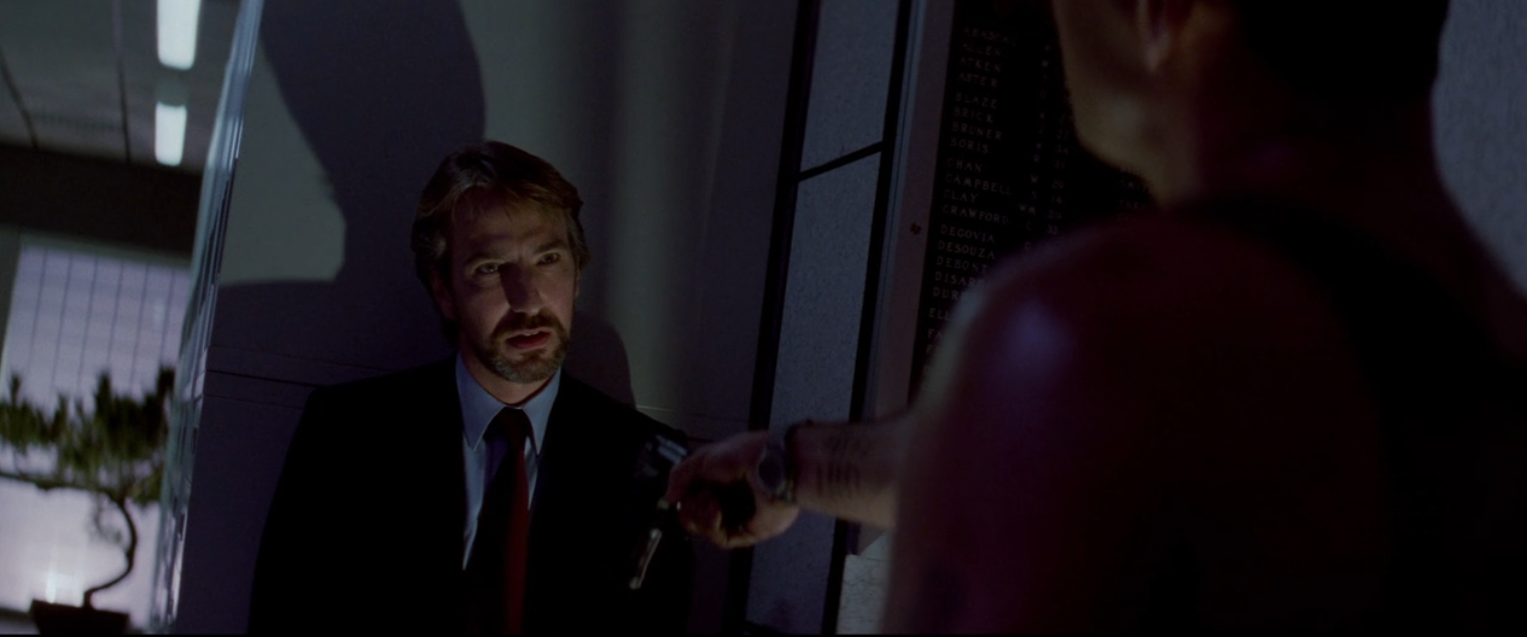
It makes sense therefore that Gruber’s wristwatch of choice be elegant but also accurate enough to coordinate the heist. The prop master’s choice is more than suitable: at several points in the film, we can see that Gruber is equipped with what looks to be a Cartier Tank. It is an appropriate choice for a villain I consider equal parts refined and ruthless; Gruber’s personality is on full display when he compliments President Takagi on using the same suit atelier mere moments before exiting him stage left.

A brief history lesson: the Tank’s origins date all the way back to World War One, its inspiration rooted in Renault-built tanks utilized by the French military. The Tank is defined by several key features such as a rectangular case, “railroad” minute track, sword hands, and a cabochon sapphire winding crown. The Normale was the first model, with the Louis following post-war circa 1922. Of all of the Tank iterations over the past century, the Louis remains the platonic ideal of a Cartier wristwatch. Outside of Cartier, one could make the argument there are few watches more iconic.
It’s a mainstream take, but color me a fan of the Cartier pick for Gruber. It levels him up in relation to his henchmen, brutish lackeys more focused on their gear’s tactical applications, and helps to set up Gruber’s image as a criminal with layers. Let’s be real: if you’re going to attempt a legendary heist, you might as well rock your Sunday best. No doubt Gruber’s Cartier is an indispensable piece of his uniform.
Double Feature
While we are sitting down to discuss Gruber, we might as well unwrap a second present in John McClane’s watch. This may strike you as a surprise, but Detective McClane is not a Cartier aficionado. Die Hard’s protagonist wears something between the opposite and the antithesis of a Tank: throughout the movie, we get enough glimpses to determine McClane is wearing a Tag Heuer Professional 3000 Quartz ref. 232.206.


At various points, we can see McClane wearing his 3000 upside down on a textile strap. I love the positioning aesthetic as a tactical choice that mirrors McClane’s active lifestyle. His career dictates that he live life on his feet (evidently barefoot), so any watch McClane equips should be visually accessible while aiming a firearm.


The 3000 series launched in 1984, the year before Techniques d’Avant Garde (aka TAG) acquired a majority stake in Heuer. It was a short run that lived within the early years of Heuer’s corporate transition: 3000-series watches were only produced until 1989, five years before the axe came down. The 3000 concept itself was intended as a premium successor to the 1000 and 2000 series, inexpensive divers that originated in the 1970s as a means of turning the Quartz crisis to the Swiss watchmaker’s advantage.

McClane’s watch is specc’ed as a 38mm quartz diver, complete with a date window cyclops, Dubois-Depraz chronograph module movement, 200 meters of water resistance, and a bi-directional bezel that has unique ball grips inlaid along the sides for better tactility. Within the 3000 catalogue, four chronographs of this ilk were made available for 1984 only. Of these four, three of them are two-tone; as the only all-steel model, the 232.206 is an incredibly scarce watch.
The 232.206 is as gritty a choice for McClane as the Tank is a distinguished one for Gruber. I love the muddled matte finish of the steel case, highly reminiscent of titanium (which would scored this watch 10 out of 10 had it been used). I also love the sharp squared-off edges of the bezel; it very much speaks to me as a watch McClane or another 80s action hero would have picked out of their own accord. Perceived fragility of the chronograph module aside, this watch being quartz-powered is also appropriate. McClane trades form for function in a way that Gruber can’t comprehend, skipping looks for accuracy the Cartier can only scrape at.
Die Hard is the Christmas gift that keeps on giving. I watch it almost every year, but it wasn’t until now that I realized how squarely it exists at the intersection of watches and cinematography. It’s an exciting thing to see watches displayed so prominently and chosen with such care in relation to the characters themselves, and I hope we get more personalities with watch lore on Gruber and McClane’s level in future films.
All screen grab images property and courtesy of 20th Century Studios.


Leave a Reply to Sarah BurchCancel reply